



Tear-Free Sunscreen for Kids: Why It Won't Sting Their Eyes (And How to Tell Before You Buy)
Your child starts crying the moment sunscreen runs near their eyes — and the next time, they resist the whole routine. Sunscreen stinging eyes is one of the most common reasons children develop a negative association with sun protection, and one of the most common reasons parents stop applying it consistently. The cause is almost always the formula — specific ingredients that irritate the delicate eye area — and it is entirely fixable by switching to the right product. This guide explains exactly why it happens and what to use instead.
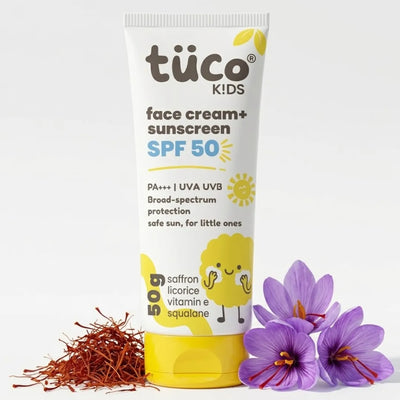
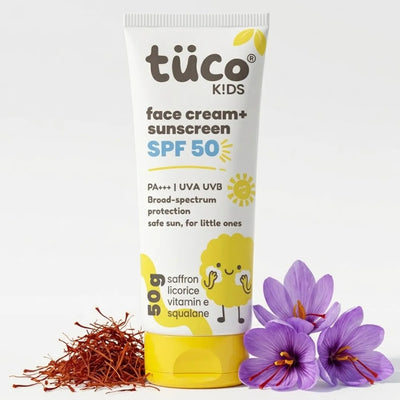
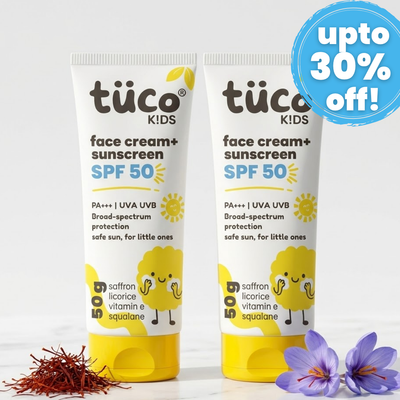
Tuco Kids tip: The fastest fix for sunscreen eye sting is switching from a chemical filter formula to a mineral one. Mineral sunscreen for kids — using zinc oxide or titanium dioxide — sits on the skin surface and is significantly less likely to sting if it migrates near the eyes during sweating or swimming. The Tuco Kids Sunscreen SPF 50 is fragrance-free, oxybenzone-free, and formulated to be gentle around the eye area — the first step to a tear-free routine.
Shop Sunscreen SPF 50 →
What's in This Guide
- Quick Comparison: Tuco Sunscreen Products
- Why Does Sunscreen Sting Children's Eyes?
- Ingredients That Cause Eye Sting vs Those That Don't
- Chemical vs Mineral Sunscreen for Kids: The Eye Sting Difference
- Application Tips That Prevent Sunscreen Reaching the Eyes
- If Sunscreen Gets in the Eyes: What to Do
- Frequently Asked Questions
- Related Reads
Quick Comparison: Tuco Sunscreen Products
| Product | Best For | Eye-Safety Features | Shop |
|---|---|---|---|
| Sunscreen SPF 50 (50gm) | Daily school use · Outdoor sports · Summer · Active kids | No oxybenzone · No synthetic fragrance · No alcohol denat · Mineral-hybrid formula · Won't sting if it migrates near eyes during sweating | Shop → |
| Sunscreen SPF 30 (30gm) | Regular school days · School bag reapplication · Ages 6m+ | Fragrance-free · Paraben-free · Lightweight formula that absorbs quickly and is less likely to run with sweat | Shop → |
| Face Care Regimen (SPF 50) | Complete morning routine · Ages 5+ · Builds consistent SPF habit | SPF 50 sunscreen included · Dermatologist-tested · Fragrance-free · Full face routine approach reduces application errors | Shop → |
| 3-in-1 Dull Skin Kit SPF 30 | UV-induced dullness + daily SPF · Ages 3+ | SPF 30 sunscreen + face wash + lotion · Complete routine reduces reliance on sunscreen alone for full-face coverage | Shop → |
| Detan Kit | Existing UV tanning or dullness · Ages 2+ | Post-sun restoration · Sulphate-free · Paraben-free · Pairs with daily SPF routine | Shop → |
Why Does Sunscreen Sting Children's Eyes?
The eye's surface — the cornea and conjunctiva — is one of the most densely innervated tissues in the body. It is extremely sensitive to foreign substances, pH imbalances, and specific irritant chemicals. When sunscreen migrates into the eye area (which happens during sweating, swimming, or when a child rubs their face), certain formula ingredients trigger the eye's pain-sensing nerve channels and cause the characteristic burning, watering, and redness.
There are three routes sunscreen reaches children's eyes:
- Sweat runoff — sweat picks up sunscreen from the forehead and temples and carries it toward the eyes. In India's heat and humidity, this is the most common route for school-going children during outdoor play and sports
- Direct application error — applying sunscreen too close to the eye or using a product that spreads easily into the eye socket area
- Rubbing — children touch their faces constantly; hands pick up sunscreen from cheeks and forehead and transfer it into the eyes during normal face-touching behaviour
The key point: how much the sunscreen stings when it reaches the eye is determined almost entirely by the formula's ingredients — not by how much sunscreen got in.
Ingredients That Cause Eye Sting vs Those That Don't
| Ingredient | Eye Sting Risk | Why |
|---|---|---|
| Oxybenzone (Benzophenone-3) | High | Chemical UV filter; highly irritating to the eye's mucous membranes; one of the most commonly reported causes of sunscreen eye burn |
| Avobenzone | High | Chemical UV filter associated with stinging; interacts with the eye's TRPV1 pain receptors |
| Octocrylene / Octisalate | Moderate to high | Chemical UV filters; commonly found in combination formulas; associated with eye irritation, particularly in children |
| Synthetic Fragrance ("Parfum") | High | Among the most well-studied eye irritants; highly reactive when it contacts the conjunctiva |
| Alcohol Denat | High | Concentrates other irritants as it evaporates; direct irritant to eye tissue |
| Certain emulsifiers and preservatives | Moderate | Older preservative systems and some emulsifiers trigger TRPA1 pain channels in the eye; more common in traditional lotion formulas |
| Zinc oxide (non-nano) | Low | Mineral; sits on skin surface; may cause a gritty sensation if it enters the eye but does not cause the same burning sting as chemical filters |
| Titanium dioxide | Low | Mineral; same as zinc oxide — physical sensation only, not chemical irritation to eye nerves |
The pattern is clear: chemical UV filters and synthetic fragrance are the primary causes of sunscreen eye sting. Mineral filters (zinc oxide, titanium dioxide) are significantly less likely to cause the burning sensation — they may produce a temporary gritty or blurry sensation from particles, but not the nerve-triggered burning that chemical formulas cause.
Chemical vs Mineral Sunscreen for Kids: The Eye Sting Difference
- Chemical sunscreens absorb into the skin — and when they migrate to the eye area via sweat, they are in a liquid, mobile form that readily contacts the cornea and conjunctiva. The same chemistry that makes them effective UV absorbers (interaction with molecular structures) is what makes them irritating to eye tissue
- Mineral sunscreens sit on the skin surface — zinc oxide and titanium dioxide particles remain on top of the skin. When sweat picks them up, they travel as suspended particles rather than dissolved irritant chemicals. Particles landing in the eye cause a gritty sensation and temporary blurriness — uncomfortable but not the sharp nerve-pain burning of chemical formulas
- Mineral-hybrid formulas are the practical choice for Indian children — pure mineral sunscreens leave a white cast on Indian skin tones, which causes compliance problems. A mineral-hybrid formula that avoids oxybenzone, avobenzone, and synthetic fragrance gives the eye-safety benefits of mineral sunscreen with a texture that children will actually tolerate daily. This is what Tuco Kids SPF 50 and SPF 30 are formulated to deliver
For children who resist sunscreen because of eye sting: The Tuco Kids Sunscreen SPF 50 contains no oxybenzone, no avobenzone, no synthetic fragrance, and no alcohol denat — the four most common causes of sunscreen eye burning. A mineral-hybrid formula that is gentle enough for daily full-face application, with no white cast on Indian skin tones.
Shop Sunscreen SPF 50 →
Application Tips That Prevent Sunscreen Reaching the Eyes
Even with the right formula, correct application technique significantly reduces how much sunscreen reaches the eye area during outdoor activity.
- Apply 15–20 minutes before going outdoors — sunscreen that has fully set on the skin is less mobile when sweat begins. Applying at the door and immediately going into the sun means the formula hasn't bonded with the skin and runs far more easily
- Never spray sunscreen near the face — always spray into the hand first, then apply to the face by hand. Sprays directed at the face disperse fine droplets that land directly in the eye area and are inhaled — neither is appropriate for children
- Apply below the brow bone, not on the eyelid — apply sunscreen to the brow bone and the area around but not on the eyelid itself. Eyelid skin is the thinnest on the body and the most vulnerable to sunscreen runoff into the eye
- Use a headband for active children in Indian summer — a wide fabric headband across the forehead catches sweat before it can pick up forehead sunscreen and channel it toward the eyes. Simple and highly effective for children who play outdoor sports
- Choose water-resistant formulas for swimming and sports — a water-resistant formula bonds more durably with the skin and runs significantly less during sweating and water activity. Reapply after 80 minutes in the water or after towelling off
- Reapply correctly — when reapplying to a child's face during the day, use a clean hand and apply in upward strokes from cheek to forehead, not downward strokes that push product toward the eye
If Sunscreen Gets in the Eyes: What to Do
- Rinse immediately with clean, cool water — hold the eye open under gently running cool water for 1–2 minutes. This is the most effective first response and usually resolves the stinging within a few minutes
- Do not rub the eye — rubbing physically pushes the irritant deeper into the conjunctiva and worsens and prolongs the stinging. Tell your child not to rub and to blink repeatedly instead — natural tears help flush the irritant out
- Saline eye drops provide faster relief — over-the-counter lubricating eye drops or saline rinse provides a more targeted flush of the eye surface than water alone and speeds up recovery from the stinging sensation
- If wearing contact lenses, remove them first — lenses trap the sunscreen against the eye surface. Remove before rinsing
- Seek medical attention if — the burning does not resolve after 20–30 minutes of rinsing; vision becomes blurred and does not clear; there is significant redness, swelling, or pain that worsens rather than improves after rinsing
For school-bag reapplication: The Tuco Kids Sunscreen SPF 30 (30gm) is compact enough to fit in any school bag or pencil case. Fragrance-free and free from chemical UV filters that cause eye sting — the safest format for midday reapplication by a child who will apply it themselves before outdoor periods.
Shop Sunscreen SPF 30 →
Frequently Asked Questions
Why does sunscreen burn my child's eyes?
The most common causes are chemical UV filters (oxybenzone, avobenzone, octocrylene) and synthetic fragrance in the formula. These ingredients are highly irritating to the eye's cornea and conjunctiva when they migrate into the eye via sweat, water, or face-touching. Switching to a mineral-based or mineral-hybrid formula free from these ingredients eliminates the burning in most cases.
What is a tear-free sunscreen for kids?
A tear-free sunscreen for kids is a formula that uses gentle, non-irritating ingredients — typically mineral filters (zinc oxide or titanium dioxide) rather than chemical UV absorbers — and is free from synthetic fragrance, alcohol denat, and harsh preservatives. These formulas do not cause the nerve-triggered burning sensation if they migrate near the eye during sweating or swimming. They make full-face application possible without distress and allow children to swim without eye burning.
Is mineral sunscreen less likely to sting eyes than chemical sunscreen?
Yes — significantly. Chemical UV filters like oxybenzone and avobenzone are dissolved actives that readily contact and irritate eye tissue when they migrate from the skin. Mineral UV filters (zinc oxide, titanium dioxide) are particles that sit on the skin surface; if they reach the eye, they may cause a gritty or blurry sensation but do not cause the sharp chemical burning that makes children cry. For any child with a history of sunscreen eye reactions, switching to a mineral or mineral-hybrid formula is the first and most effective fix.
How do I stop sunscreen from running into my child's eyes during sports?
Four most effective steps: (1) apply 15–20 minutes before activity so the formula sets fully; (2) choose a water-resistant formula — water-resistant sunscreens bond more durably with the skin and run significantly less under sweat; (3) use a fabric headband across the forehead to intercept sweat before it picks up forehead sunscreen; (4) apply below the brow bone rather than directly on the eyelid, in upward strokes from cheek to forehead.
What should I do if sunscreen gets in my child's eyes?
Rinse immediately with clean, cool water for 1–2 minutes — hold the eye open under gently running water. Do not let the child rub their eye; rubbing worsens the irritation. Saline eye drops speed up recovery. The stinging should resolve within a few minutes of thorough rinsing. If it doesn't resolve after 20–30 minutes, or if vision is affected, consult a doctor.
Can I use sunscreen near my child's eyes?
Yes — with the right formula and technique. Apply to the brow bone and cheekbone area but not directly on the eyelid. A mineral or mineral-hybrid formula that is fragrance-free and oxybenzone-free is appropriate for use close to the eye. Avoid chemical sunscreens, fragrance-containing formulas, and sprays near the face entirely for children.
My child refuses sunscreen because it stings — what should I do?
This is a formula problem, not a behaviour problem. A child who has had sunscreen sting their eyes will resist it — a completely understandable response. The solution is switching to a mineral sunscreen for kids free from the four main sting-causing ingredients (oxybenzone, avobenzone, synthetic fragrance, alcohol denat), letting the child apply a small amount to their own arm to see that it doesn't sting, and then reintroducing the routine. Most children's resistance to sunscreen disappears within a few applications once the right formula is found.
Related Reads
- Best Sunscreen for Kids in India: SPF 30 vs SPF 50 — What Really Protects Your Child
- Sunscreen for Babies and Toddlers (0–2 Years): What's Actually Safe to Use in India
- Does Sunscreen Block Vitamin D in Kids? What Indian Parents Should Know
- Best Sunscreen for Girls with Sensitive Skin: Gentle Care for Every Sunny Day
- What PA Ratings Mean in Sunscreen and When PA++++ Makes a Difference
- Which SPF Sunscreen Is Best for Teenage Girls?