



Why Is My Child's Scalp So Itchy? A Parent's Diagnostic Guide
If your child keeps scratching their head and you can't tell whether it's dandruff, lice, dry scalp, eczema, ringworm, or product buildup — you're not alone. These six conditions look remarkably similar on the surface, but they have completely different causes and different solutions. Treating the wrong one wastes time, money, and risks making the right problem worse. This guide gives you a clear, no-guesswork decision tree to identify exactly what causes itchy scalp in school children — and what to do about it first at home, before deciding whether you need a doctor.
Tuco Kids tip: If your child is scratching and you're not yet sure what's causing it, the safest first step is switching to a gentle, sulphate-free shampoo that won't further irritate any scalp condition. The Reetha Shampoo for Kids is a good neutral starting point — it cleanses gently without stripping natural oils or worsening any underlying scalp condition while you diagnose.
Shop Reetha Shampoo →
What's in This Guide
- The Decision Tree: Which Condition Does Your Child Have?
- Quick Comparison: Conditions, Symptoms & Tuco Solutions
- Dandruff (Seborrheic Dermatitis)
- Dry Scalp
- Head Lice
- Scalp Eczema
- Ringworm (Tinea Capitis)
- Product Buildup
- Frequently Asked Questions
- Related Reads
The Decision Tree: Which Condition Does Your Child Have?
Start here. Answer each question about what you can actually see and feel on your child's scalp right now.
| What You See / Feel | Most Likely Condition | Go To Section |
|---|---|---|
| White or yellowish flakes that fall freely off the hair; scalp feels oily or normal | Dandruff | Dandruff → |
| Small, fine, powdery white flakes; scalp feels tight and dry; worse in winter or AC | Dry Scalp | Dry Scalp → |
| Intense itching — especially at night; oval specks stuck firmly to the hair shaft; you may see movement | Head Lice | Lice → |
| Red, inflamed, weeping patches on scalp; child also has eczema elsewhere on the body (elbows, knees) | Scalp Eczema | Eczema → |
| Circular bald patches with a ring-shaped scaly border; some hair loss; may see pus-filled bumps | Ringworm (Tinea Capitis) | Ringworm → |
| Flakes that feel waxy or thick; scalp smells; started after changing shampoo or using hair gel/oil daily | Product Buildup | Product Buildup → |
Still not sure? If you see flakes but no itching, it's more likely dry scalp or buildup. If itching is intense and started suddenly after school, check for lice first — it's the most common reason my kid keeps scratching her head after returning from class.
Quick Comparison: All 6 Conditions at a Glance
| Condition | Key Visual Sign | Itchy? | Contagious? | Tuco Solution | See a Doctor? |
|---|---|---|---|---|---|
| Dandruff | Loose white/yellow flakes | Yes — moderate | No | Anti-Dandruff Kit | If no improvement in 4–6 weeks |
| Dry Scalp | Fine, powdery white flakes; tight scalp | Mild | No | Champi Kit | If it persists through season change |
| Head Lice | Oval nits stuck to hair shaft; live lice visible | Yes — intense, at night | Yes | Anti-Lice Kit | If two treatment cycles don't clear |
| Scalp Eczema | Red, weeping, inflamed patches | Yes — burning + itch | No | Natural Shampoo | Yes — usually needs dermatologist |
| Ringworm | Circular bald patch with scaly ring border | Yes — intense | Yes | See doctor first | Always — needs prescription antifungal |
| Product Buildup | Waxy, thick flakes; scalp smells; near hairline | Mild to moderate | No | Reetha Shampoo | Rarely — resolves with correct washing |
1. Dandruff (Seborrheic Dermatitis)
What it looks like
- Flakes: white or slightly yellowish, medium-sized, and oily — they fall freely off the hair when touched or combed
- Scalp feel: oily or normal at the root, not dry or tight
- Itch level: moderate — persistent but not the sharp, intense itch of lice
- Location: throughout the scalp, often heavier at the crown and parting; in severe cases extends to the eyebrows and hairline
- Common age: picks up from 8–10 onwards as sebum production increases; peaks in pre-teens and teens
First-line home remedies
- Switch shampoos immediately: most cases of scalp itching in children caused by dandruff respond to a sulphate-free, antifungal-botanical shampoo used 2–3 times per week. The Flake Fighter Shampoo uses mint and ginger, natural anti-fungals— to target the underlying Malassezia fungus without harsh chemicals
- Neem leaf rinse: boil 20–25 neem leaves in 2 cups of water, cool, and use as a post-shampoo final rinse. Safe for children aged 3+. Neem is one of the most studied natural antifungals available
- Pre-wash coconut oil: apply 30–60 minutes before shampooing only — not overnight. Overnight oiling when dandruff is active feeds the Malassezia fungus
- Curd mask: apply plain, unsweetened curd to the scalp for 20–30 minutes, then wash off. Lactic acid loosens flakes; probiotics help rebalance the scalp microbiome
When to see a doctor
- No improvement after 4–6 weeks of consistent antifungal shampoo use
- Flaking extends to face, eyebrows, ears, or chest — may indicate more severe seborrheic dermatitis
- Scalp becomes red, swollen, or painful to touch
Dandruff: The anti-dandruff kit targets the root cause of dandruff — the Malassezia fungus — using mint & ginger's natural anti-dandruff properties, that attack kids scalp itching causes. Sulphate-free, tear-free, safe for ages 3+.
Shop Anti-Dandruff Kit
2. Dry Scalp
What it looks like
- Flakes: small, fine, and powdery white — lighter than dandruff flakes, and the scalp feels dry, not oily
- Scalp feel: tight, sometimes sensitive to touch; may feel rough or papery
- Itch level: mild to moderate — often described as a persistent dull tightness rather than sharp itching
- Seasonal pattern: peaks in winter and in heavily air-conditioned environments; improves in humid weather
- Trigger clue: often starts or worsens after switching to a new shampoo, or after a period of very frequent washing
Dry scalp vs dandruff — the key test: pick up a single flake and rub it between your fingers. Dry scalp flakes disintegrate into a fine powder. Dandruff flakes feel slightly greasy and hold together. This distinction is consistently missed by parents and is one of the most common reasons child itchy scalp not dandruff searches spike — the parent has already ruled out the obvious but is treating the wrong thing.
First-line home remedies
- Weekly oil massage (champi): apply warm coconut or almond oil to the scalp 30–60 minutes before washing. This is the most effective single intervention for dry scalp in children. The Champi Kit bundles a kid-safe scalp oil with a gentle shampoo and conditioner designed for this exact pre-wash-to-wash ritual
- Reduce washing frequency: switch to 2 times per week maximum in winter — daily washing is the most common cause of dry scalp in school-going children
- Aloe vera gel: apply directly to the scalp for 15–20 minutes before washing. Soothes tightness immediately; safe for all ages
- Switch shampoos: use a moisturising, sulphate-free formula rather than one designed for dandruff — treating dry scalp with an antifungal shampoo can worsen the dryness
When to see a doctor
- Dryness and flaking persist through a full seasonal change despite oil massage and shampoo switch
- Scalp becomes cracked or bleeds from scratching
- Child develops dry patches elsewhere on the body at the same time — may indicate eczema
Dry scalp: The Champi Kit — Hair Oil + Reetha Shampoo + Conditioner — is built for the traditional Indian pre-wash oil ritual that restores scalp moisture before cleansing. The most effective itchy scalp child home remedy for dry scalp, in one kit. Rated 4.84★ by 580+ parents.
Shop Champi Kit →
 3. Head Lice
What it looks like
- Nits (eggs): oval, teardrop-shaped specks — white to yellowish — glued firmly to individual hair shafts within 1 cm of the scalp. Unlike dandruff flakes, they do not slide off when you pull at them
- Live lice: sesame-seed-sized, greyish-brown insects that move quickly across the scalp — most visible under bright light, parting hair section by section
- Itch pattern: intense itching that is distinctly worse at night — lice are most active in the dark
- Location: concentrate behind the ears and at the nape of the neck — the warmest areas of the scalp
- Trigger clue: sudden onset of intense scratching within 1–3 weeks of school reopening, a class trip, or a playdate
The most important diagnostic step: do a wet comb check. Dampen your child's hair with conditioner (it slows lice movement), then comb through with a fine-toothed nit comb under bright light, section by section. Wipe the comb on a white tissue after each stroke. If you see moving insects or oval specks — that's lice, not dandruff.
First-line home treatment
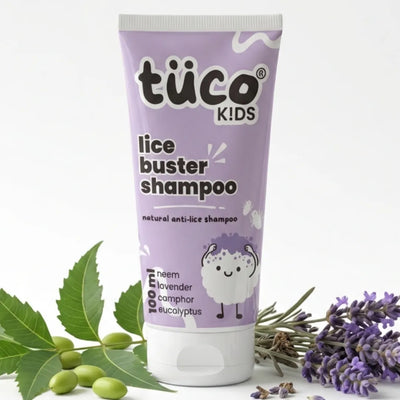
- Use a dedicated lice treatment immediately: a standard shampoo — even an antifungal dandruff shampoo — has no effect on lice. You need a child head itching remedy formulated specifically for lice. The Tuco Lice Shampoo uses neem, lavender, and camphor — ingredients that suffocate lice without neurotoxic pesticides like permethrin
- Follow the repeat-treatment protocol: apply on Day 1 and again on Day 7–10 to catch newly hatched lice from any eggs the first treatment missed. Skipping the second treatment is the most common reason lice return
- Comb after every wash: use a nit comb to physically remove dead nits — the shampoo kills live lice but doesn't dissolve the glue holding nits to the shaft
- Wash all contact items: pillowcases, hats, hair ties, and shared combs on a hot cycle. Lice cannot jump or fly — they transfer only through direct head-to-head contact or shared items
- Check all siblings: by the time one child is symptomatic, siblings often have an early infestation too
When to see a doctor
- Two full treatment cycles (Day 1 and Day 7–10) haven't cleared the infestation — may indicate treatment-resistant lice
- Scalp develops sores, crusting, or oozing from scratching — secondary bacterial infection
- Swollen lymph nodes at the back of the neck or behind the ears
Lice: The Anti-Lice Kit gives you the shampoo, nit comb, and the correct two-treatment protocol in one pack — everything you need for a complete lice clearance. No permethrin, no harsh pesticides. Or grab the standalone Lice Shampoo if you already have a comb.
Get Lice-Free →
4. Scalp Eczema (Atopic Dermatitis)
What it looks like
- Skin appearance: red, inflamed patches on the scalp — may weep, crust, or bleed if scratched repeatedly
- Flaking: present, but the flakes come with visible redness and irritation beneath — not the clean-looking flaking of dry scalp
- Itch level: intense — a burning itch that can disrupt sleep and focus in school
- Body connection: children with scalp eczema almost always have eczema elsewhere — the elbows, backs of knees, hands, and face are the most common co-locations in Indian children
- Trigger clues: worsens with specific shampoos (especially those with synthetic fragrance or SLS), hot weather, stress, certain foods, and sweat
First-line home management
- Eliminate the trigger shampoo immediately: SLS (sulphate), synthetic fragrance, and parabens are the most common contact dermatitis triggers in children's scalps. Switch to a completely fragrance-free, sulphate-free formula like the Natural Shampoo for Kids — formulated without any of these irritants
- Wash with lukewarm water only: hot water acutely worsens eczema inflammation
- Pat dry, never rub: friction from towel drying worsens the inflammatory response in eczema-affected scalp skin
- Avoid oil massage during a flare: oiling an actively inflamed eczema scalp can trap heat and worsen the condition. Reserve champi for calm periods between flares
- Aloe vera gel: apply to calm patches — its anti-inflammatory compounds provide immediate itch relief without the risk of further irritation
When to see a doctor
- Eczema typically requires dermatologist guidance for prescription topical steroids or calcineurin inhibitors during flares — home management alone is rarely sufficient for moderate-to-severe cases
- See a doctor if patches weep, bleed, or show signs of secondary infection (warmth, yellow crusting)
- If your child's sleep is regularly disrupted by scalp itching
Eczema-prone scalps: The Natural Shampoo for Kids (Pack of 3) is completely free from SLS, parabens, synthetic fragrance, and artificial colour — the four most common contact allergens in children's shampoos. Formulated for the most sensitive young scalps. Why does my child have an itchy scalp after washing? In many cases, it's their shampoo.
Shop Natural Shampoo →5. Ringworm (Tinea Capitis)
What it looks like
- Appearance: one or more circular or oval bald patches on the scalp, typically 1–5 cm in diameter, with a scaly or crusty ring-shaped border — the "ringworm" name comes from this ring pattern, not an actual worm
- Hair: hair breaks off at or near the scalp within the affected patch, leaving short stubble — distinct from the broader thinning of eczema
- Itch level: intense; in severe forms (kerion), the patch may become swollen, pus-filled, and extremely tender to touch
- Contagious: yes — spreads through direct scalp contact, shared combs, hats, or via household pets (cats and dogs can carry the fungus)
- At-risk age: most common in children aged 3–12; significantly more common in boys than girls in Indian data
What NOT to do at home
- Do not attempt to treat ringworm with a dandruff shampoo, coconut oil, or any topical home remedy alone — tinea capitis is a deep fungal infection of the hair follicle that requires oral antifungal medication to clear
- Do not share combs, towels, or hair accessories while the infection is active
- Check household pets — ringworm transmission from cats and dogs to children is more common than most parents realise
When to see a doctor
- Always and immediately — ringworm of the scalp (tinea capitis) cannot be resolved without prescription oral antifungal medication (typically griseofulvin or terbinafine). Topical treatments alone do not penetrate the hair follicle deeply enough to clear the infection
- A medicated shampoo may be prescribed alongside oral medication to reduce shedding of fungal spores, but it is not a standalone treatment
Ringworm note: This is the one condition on this list that cannot be treated at home first. See a paediatrician or dermatologist as soon as you suspect it — the ring-shaped bald patch with scaly border is usually distinctive enough to identify. Once ringworm is ruled out or being treated by a doctor, return here for guidance on the other five conditions.
6. Product Buildup
What it looks like
- Flakes: waxy, thick, and yellowish rather than the dry, powdery flakes of dry scalp or the greasy-but-loose flakes of dandruff — often concentrated near the hairline and crown
- Scalp feel: coated or slightly sticky rather than oily or dry
- Smell: a stale or sour scalp odour is often the clearest sign — it's the smell of old product mixed with scalp oils and sweat
- Itch level: mild to moderate; more accurately described as irritation or tightness than true itching
- Trigger clue: started after beginning overnight oiling, using hair gel or styling products, or switching to a shampoo that isn't being rinsed out thoroughly
Product buildup is one of the most underdiagnosed causes of itchy scalp in kids in India specifically — the culprit is often a well-intentioned overnight oiling routine, which over time creates a layer of oxidised oil, dead skin cells, and product residue that a gentle shampoo can't fully remove in a single wash.
First-line home remedies
- Clarifying wash: a diluted apple cider vinegar rinse (1 teaspoon in 1 cup of water, poured over the scalp post-shampoo) breaks down oil and product buildup. Leave for 2–3 minutes, rinse thoroughly. Safe for children aged 5+; patch-test first
- Switch to Reetha Shampoo: reetha (soapnut) is one of the most effective natural clarifying agents — it cuts through oil buildup far more effectively than standard shampoos while being gentle enough for children. Reetha Shampoo is particularly effective for the hard-water cities (Bengaluru, Delhi, Mumbai) where mineral deposits compound the buildup problem
- Stop overnight oiling immediately: switch to a pre-wash oil application (30–60 minutes before shampooing) rather than overnight. This gives the same scalp nourishment without the buildup
- Extend rinse time: rinse shampoo for at least 60 seconds after lathering — incomplete rinsing is the second most common cause of scalp buildup in school-going children
When to see a doctor
- Rarely necessary — product buildup resolves with corrected habits and a clarifying shampoo within 2–3 weeks
- If flaking and irritation continue after stopping all oiling and switching to a clarifying shampoo for 3 weeks, reconsider whether the condition is actually dandruff or seborrheic dermatitis
Tangly hair between washes? If your child's hair tangles and frizzes between wash days — making you want to wash more often and creating more buildup — the Tangled and Frizzy Hair Regimen is designed to reduce knots and frizz between washes, so you can stretch wash days without the scalp irritation that comes from either over-washing or over-oiling.
Find Your Solution →Frequently Asked Questions
Questions sourced from Google's People Also Ask and People Also Search For results for "itchy scalp in kids", "why does my child have an itchy scalp", and "child itchy scalp not dandruff" — June 2026.
Why does my child keep scratching their head but I can't see any lice?
No visible lice doesn't rule out an infestation — lice are fast-moving and avoid light, so they're often missed on a quick visual check. Do a proper wet-comb test: apply conditioner to damp hair, comb through in small sections with a fine-toothed nit comb, and wipe on a white tissue after each stroke. If that comes back clear, the scratching is more likely dandruff, dry scalp, or product buildup.
My child has an itchy scalp but no dandruff — what could it be?
Child itchy scalp not dandruff is one of the most-searched scalp questions by Indian parents — and the most common causes are dry scalp (no visible flakes, just tightness and itch), product buildup (waxy residue near hairline), scalp eczema (red patches that may not be producing many flakes yet), or early-stage lice (before the child starts producing enough histamine to itch significantly). Work through the decision tree at the top of this guide.
What is the fastest home remedy for an itchy scalp in children?
The fastest immediate relief is an itchy scalp child home remedy of pure aloe vera gel applied directly to the scalp for 20 minutes before washing — it provides anti-inflammatory relief within minutes. For a lasting fix, the solution depends on the cause: antifungal shampoo for dandruff, oil massage for dry scalp, lice treatment for lice, and a fragrance-free shampoo switch for eczema or buildup.
Can a child's itchy scalp be caused by their shampoo?
Yes — and this is more common than most parents realise. Synthetic fragrances (listed as "parfum"), SLS (sulphates), artificial colours, and parabens in mainstream kids' shampoos are the most common contact allergens causing scalp irritation in children. If scalp itching in children started after changing shampoo or worsens after every wash, the shampoo is likely the trigger. Switch to a completely fragrance-free, sulphate-free formula immediately.
How do I tell the difference between dandruff and lice in my child's hair?
The single fastest test: try to slide a white speck off the hair shaft with two fingers. Dandruff flakes slide off freely. Lice eggs (nits) are glued to the shaft with a water-resistant cement and won't budge when you try to move them. Also check the itch pattern — lice itch is most intense at night; dandruff itch is consistent throughout the day. If you confirm lice, don't use a dandruff shampoo — it won't work. Use the Anti-Lice Kit immediately.
Can dandruff cause hair loss in children?
Mild dandruff does not directly cause hair loss. However, repeated intense scratching can damage hair follicles, leading to temporary hair thinning. If you notice bald patches alongside flaking, this is more likely ringworm (tinea capitis) than dandruff — the two conditions are frequently confused and ringworm requires a doctor. See the Ringworm section above.
What causes itchy scalp in school children specifically?
There are four what causes itchy scalp in school children patterns that are distinctly school-related: (1) lice from head-to-head contact at school — most outbreaks happen in the first 4–6 weeks after school reopens; (2) sweat buildup from outdoor play and PE that isn't washed out before the next school day; (3) hard water scalp deposits in cities like Delhi and Bengaluru that build up through the week; (4) product buildup from well-intentioned daily oiling routines before school. The first question to ask is: when did it start relative to the school calendar?
Is it safe to use coconut oil on an itchy scalp in children?
It depends on the cause. Coconut oil is excellent for dry scalp — applied pre-wash for 30–60 minutes and rinsed out thoroughly. For dandruff-prone scalps, overnight coconut oil should be avoided as it feeds the Malassezia fungus. For eczema or ringworm, don't apply oil during an active flare. For lice, coconut oil alone doesn't kill lice — it may temporarily slow them but won't clear an infestation.
Related Reads
- Best Shampoo for Kids in India — 3 Gentle, Tear-Free Picks for Healthy Hair
- Unveiling the Best Anti-Dandruff Shampoos for Kids
- Why Your Child Should Never Use Adult Shampoo: The Importance of Tear-Free, Kid-Friendly Hair Care
- What Is Coco Glucoside, and Why Is It in Your Child's Shampoo?