



Best Sunscreen for Kids in India: SPF 30 vs SPF 50: What Really Protects Your Child?
India has one of the highest UV index ratings in the world, especially between March and October. While adults are becoming increasingly sunscreen-savvy, most parents are still unsure about sunscreen for kids — which SPF to choose, whether chemical or mineral is safer, and why the "kids" label on a bottle actually matters. When parents search for the kids best sunscreen in india, the criteria that matter most are not brand names or price — they are mineral vs chemical filters, SPF and PA rating, and whether the formula is actually tested for children's skin. This guide gives Indian parents a practical, researched answer to all of it.
The truth is, children's skin is more vulnerable to UV damage than adult skin. UV exposure during childhood is directly linked to long-term risks including premature ageing, hyperpigmentation, and elevated lifetime risk of skin cancer. This is why parents actively search for the best sunscreen for kids in india, the best kids sunscreen in india, and even the best baby sunscreen in india — and why the answer genuinely differs by age.
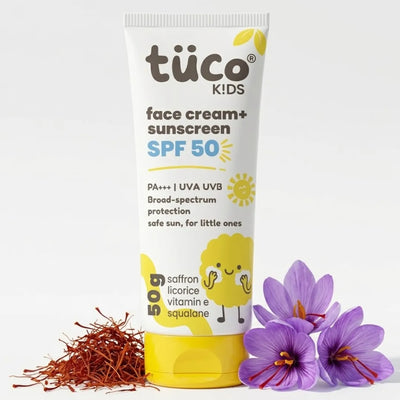
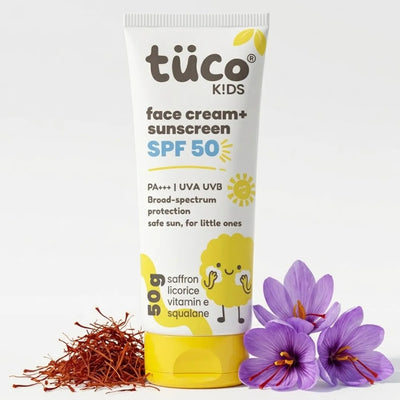
Tuco Kids tip: The most common mistake Indian parents make is applying sunscreen only on beach trips or holidays. UV exposure in Indian cities is intense and year-round — the school commute, outdoor sports periods, and time near classroom windows all accumulate UV damage. Daily sunscreen should be as automatic as brushing teeth. The Tuco Kids Sunscreen SPF 50 is formulated for Indian children's skin tones and the specific UV exposure conditions of Indian school life — no white cast, no greasy feel, safe from age 3.
Shop Sunscreen SPF 50 →
What's in This Guide
- Chemical vs Mineral Sunscreen: What's Safer for Kids?
- Sunscreen for Kids by Age: What Indian Parents Need to Know
- What Is PA Rating in Sunscreen? (And Why It Matters for Indian Kids)
- SPF 30 vs SPF 50 for Kids: Side-by-Side Comparison
- Sunscreen Ingredients to Avoid for Kids
- Best Sunscreens for Kids in India: Tuco Picks
- Pro Tips for Applying Sunscreen on Kids
- Frequently Asked Questions
- Related Reads
Chemical vs Mineral Sunscreen: What's Safer for Kids?
This is the first question most parents ask when looking for the best sunscreen for kids — and the answer matters more for children than for adults.
- Chemical sunscreens use UV-absorbing filters (like oxybenzone, avobenzone, octinoxate) that convert UV rays into heat. These are lightweight and easy to apply but can irritate sensitive skin and are associated with hormonal disruption concerns in young children, which is why many paediatric dermatologists avoid recommending adult chemical sunscreens for use on kids
- Mineral sunscreens use zinc oxide and/or titanium dioxide to physically block UV rays. They sit on top of the skin rather than absorbing into it, making them the preferred choice for children — especially those under 6 whose skin barrier is still developing
- Recommendation for kids: mineral-based or mineral-hybrid sunscreens are the gold standard for children under 12 and are widely considered the best mineral sunscreen for kids in india. For older children and teenagers, a hybrid mineral-chemical formula that avoids oxybenzone and octinoxate provides the same gentle safety with a lighter texture
- The white cast issue on Indian skin: pure mineral sunscreens with large-particle zinc oxide leave a visible grey or chalky cast on darker Indian skin tones. This is the primary reason children resist wearing them. Look specifically for formulas designed for Indian skin tones that use micronised mineral particles — these provide the same protection without the white residue
Sunscreen for Kids by Age: What Indian Parents Need to Know
Choosing the kids best sunscreen is not one-size-fits-all — a newborn's skin needs are fundamentally different from a 10-year-old's or a 12-year-old's. Here is a complete guide for Indian parents by age group.
| Age Group | Recommendation | SPF | Key Notes |
|---|---|---|---|
| 0–6 months | Avoid sunscreen entirely — keep baby in shade, use UPF clothing | N/A | Skin is too thin and permeable for any active ingredients |
| 6 months–2 years | Mineral-only (zinc oxide). Small amounts on exposed skin only. | SPF 30+ | Best baby sunscreen in India option: fragrance-free, zinc oxide only, patch-test first |
| 2–5 years | Mineral sunscreen, broad spectrum. Reapply every 2 hours outdoors. | SPF 30–50 | Focus on face, neck, and arms. Avoid eyes. Child-specific formula only |
| 5–12 years (school age) | SPF 50 recommended for Indian sun exposure. Lightweight, non-greasy formula for daily school use. | SPF 50 | Also the right choice as the best sunscreen for 10 year old in india and the best sunscreen for 12 year old in india — school hours overlap peak UV time (10am–3pm). At age 12, early puberty means sebum production is beginning to increase; choose a non-comedogenic formula |
| Teens (13+) | SPF 50, PA+++ or higher. Gel or matte formula for acne-prone skin. | SPF 50 | Non-comedogenic formula is important — puberty hormones make skin oilier and more acne-prone. Never use adult formulas with oxybenzone on teenage skin |
For a 10-year-old child specifically — Indian summers are intense, and most school hours fall between 10am and 3pm (the peak UV window). An SPF 50, PA+++ broad-spectrum sunscreen applied 20 minutes before stepping out is the standard recommendation from Indian dermatologists. Look for a lightweight, water-resistant formula that won't feel heavy under a school uniform.
10 साल के बच्चे के लिए सनस्क्रीन: SPF 50 और PA+++ वाला mineral sunscreen सबसे सुरक्षित विकल्प है। इसे बाहर जाने से 20 मिनट पहले लगाएं।
Made for Indian kids, not imported skin types. The Tuco Kids Sunscreen SPF 50 is formulated for Indian children's skin tones and tested for the kind of UV exposure kids face in Indian summers — school runs, outdoor play, summer camps. No white cast on Indian skin. No harsh chemical filters. Safe from age 3.
Shop Tuco Sunscreen SPF 50 →What Is PA Rating in Sunscreen? (And Why It Matters for Indian Kids)
Most Indian parents focus only on SPF — but the PA rating is equally important, especially in India where UVA rays are intense year-round. A sunscreen without a PA rating, or with a low one, is only doing half the job.
- SPF measures protection against UVB rays — the ones that cause sunburn
- PA rating measures protection against UVA rays — the ones that cause tanning, UV-induced dullness, and deeper skin damage that accumulates silently over months and years
| PA Rating | Protection Level | Suitable For |
|---|---|---|
| PA+ | Some UVA protection (PPD 2–4) | Indoor use, brief outdoor exposure — not adequate for Indian UV conditions |
| PA++ | Moderate UVA protection (PPD 4–8) | Everyday use in mild sun — minimum acceptable only in low-UV environments |
| PA+++ | High UVA protection (PPD 8–16) | Daily school use, Indian climate — recommended minimum for all school-going children |
| PA++++ | Extremely high UVA protection (PPD 16+) | Beach, hills, summer camps, sports, prolonged outdoor activity — and the recommended standard for South Indian cities year-round |
For Indian kids, look for a minimum PA+++ on any sunscreen you buy. Many imported sunscreens — particularly US and European brands — don't carry a PA rating at all. For India's UV Index of 8–11, that is not adequate. Always check both SPF and PA rating before purchasing. Tuco Kids SPF 50 carries PA++++ — the highest available UVA protection.
SPF 30 vs SPF 50 for Kids: Side-by-Side Comparison
Both SPF 30 and SPF 50 are widely recommended — but the difference matters more in the Indian context than most parents realise.
| Factor | SPF 30 | SPF 50 |
|---|---|---|
| UVB blocked | ~97% | ~98% |
| Reapplication needed | Every 2 hours | Every 2 hours (same — higher SPF does not extend wear time) |
| Best for | Indoor-heavy days, brief morning or evening commute, winter months in North India | School days with outdoor periods, sports, summer months, beach — recommended for most Indian kids |
| Indian UV context | Adequate only if reapplied perfectly every 2 hours — which most children do not do | Better protection buffer for missed or partial reapplication in real-world school conditions |
| Texture | Usually lighter, easier to apply quickly | Can be slightly richer — look specifically for lightweight, non-greasy formulas designed for children |
| Verdict for India | Minimum acceptable; use for school-bag reapplication | Recommended daily standard for Indian kids |
| Tuco product | Sunscreen SPF 30 (30gm) — compact, school-bag friendly | Sunscreen SPF 50 (50gm) — daily Indian sun standard |
The practical difference: SPF 30 blocks 97% of UVB; SPF 50 blocks 98%. That 1% sounds small — but in India's UV Index 8–11 conditions (April to September across most cities), that extra margin matters considerably, especially since children rarely reapply perfectly on schedule. For a 10-year-old spending 6+ hours at school with outdoor periods, SPF 50 is the safer practical choice.
Can't decide between SPF 30 and SPF 50? The simplest approach: keep SPF 50 as the morning application before school, and keep SPF 30 (30gm) in the school bag for a practical midday reapplication. Both are mineral-based and formulated for Indian children's skin.
Shop SPF 50 → Shop SPF 30 →Sunscreen Ingredients to Avoid for Kids (India Parent Guide)
Not all sunscreens are created equal — and some chemical filters commonly used in adult sunscreens have no business being on a child's skin. Here is what to check on the label when looking for the best kids sunscreen in india:
| Ingredient | Why to Avoid for Kids | Commonly Found In |
|---|---|---|
| Oxybenzone (Benzophenone-3) | Hormone-disrupting potential; absorbed through the skin; detected in blood and breast milk; banned or restricted for children in several countries | Many imported chemical sunscreens; adult Indian pharmacy sunscreens |
| Octinoxate (Ethylhexyl Methoxycinnamate) | Endocrine disruptor; animal studies show effects on thyroid function; absorbed through the skin | Budget chemical sunscreens; most adult sunscreens |
| Homosalate | Accumulates in the body over time; disrupts hormone activity; FDA has flagged it for further safety review | Multi-filter chemical sunscreens |
| Retinyl Palmitate | A vitamin A derivative that may accelerate skin damage under UV exposure (flagged in FDA studies) | Some "enriched" or anti-ageing sunscreens |
| Synthetic Fragrance ("Parfum") | The most common contact allergen in cosmetics; can trigger eczema flares and contact dermatitis on children's more permeable skin | Most branded mass-market sunscreens |
| Nano Zinc Oxide | Nano-particles may penetrate the skin barrier — always choose non-nano zinc oxide formulations for children | Some lightweight mineral sunscreens |
Safe alternatives: look for sunscreens with non-nano zinc oxide or titanium dioxide as the active ingredient — these sit on the skin surface and reflect UV rather than being absorbed into it. They are the safest option for children under 12 and for all sensitive skin types. All Tuco Kids sunscreens are free from oxybenzone, octinoxate, homosalate, synthetic fragrance, and nano particles.
Best Sunscreens for Kids in India: Tuco Picks
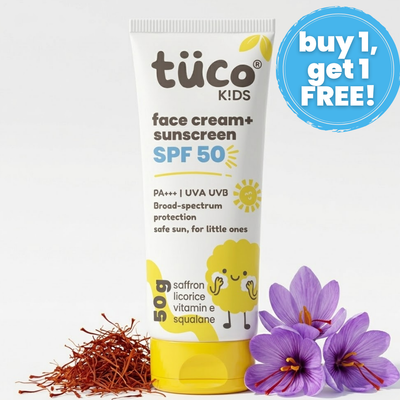
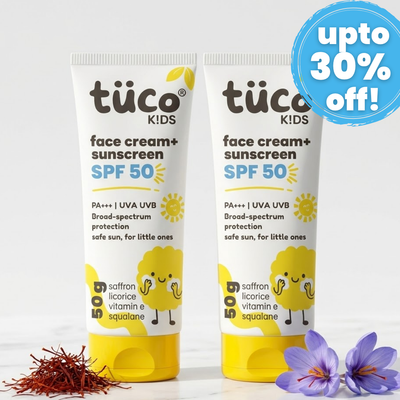
1. Tuco Kids Sunscreen SPF 50 (50gm)

The best sunscreen for kids in india for outdoor-active children and daily Indian UV conditions. Unlike many mineral sunscreens that leave a chalky white cast on Indian skin tones, the Tuco Kids SPF 50 is designed to blend in naturally on brown and wheatish skin — making it one of the most consistently used kids best sunscreen options for Indian families.
- SPF 50 broad-spectrum UVA and UVB protection
- Mineral-based formula — safer for children than chemical filters
- No white cast on Indian skin tones
- Non-comedogenic, lightweight texture — does not clog pores or feel heavy
- Free from oxybenzone, octinoxate, parabens, synthetic fragrance, and nano particles
- Dermatologist-tested for Indian children's skin from age 3
- Best for: daily school use, outdoor sports, summer camps, beach trips, all Indian skin tones
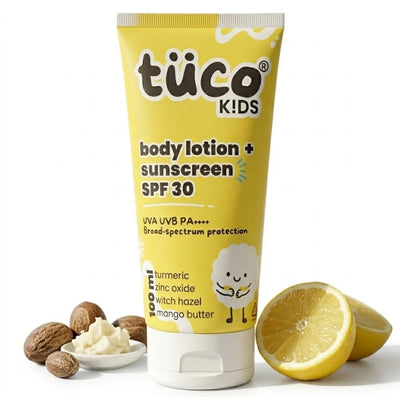
2. Tuco Kids Sunscreen SPF 30 (30gms)
For everyday school commutes and indoor-heavy school days, the Tuco Kids Sunscreen SPF 30 is a practical and affordable daily choice. It still provides over 97% UVB protection and full UVA coverage, with a lighter, more comfortable daily-wear texture. The compact 30gm size is the most school-bag-friendly format available — it fits in any pencil case and makes midday reapplication a realistic habit rather than an occasional one.
- SPF 30 broad-spectrum protection — ideal for daily indoor-leaning school days
- Lightweight, daily-wear texture — more comfortable than SPF 50 formulas for everyday application
- Compact 30gm size — school-bag and travel friendly
- Same safe formula — no harsh chemical filters, no parabens, no synthetic fragrance
- Suitable for children aged 3 and above
- Best for: regular school days, city kids, overcast or winter days, school-bag reapplication between the morning application and after-school activity
Pro Tips for Applying Sunscreen on Kids
- Apply 20–30 minutes before sun exposure — sunscreen needs time to form a proper protective layer on the skin; applying at the door as you leave does not give adequate time
- Don't miss the ears, neck, and back of hands — these are the most commonly forgotten spots and show UV damage first in Indian children because they're consistently skipped
- Reapply every 2 hours outdoors — no sunscreen, regardless of SPF number, lasts all day. This is the single most important application rule and the one most commonly ignored
- Use the right amount: approximately 1/4 teaspoon (1.25ml) for the face and neck; a palmful for the body. Most parents apply roughly half the needed amount, which dramatically reduces effective protection regardless of SPF
- Avoid spray sunscreens for young children — inhalation risk is a concern with aerosol formulas; stick to cream or lotion formats for children under 10
- Don't rely on SPF in moisturisers or makeup alone — the layer of moisturiser or foundation applied on a real face is too thin to deliver the labelled SPF. Sunscreen must always be a standalone product
- Make it part of the morning routine before the school bag goes on — sunscreen that is applied as part of a fixed routine gets applied; sunscreen left for "when we remember" does not
Frequently Asked Questions
What SPF should I use for kids in India?
SPF 30 for everyday indoor and light school use; SPF 50 or above for any outdoor activity, sports, beach trips, or summer months. Given India's UV Index of 8–11 across most cities from March to October, SPF 50 is the more practical daily standard for school-going children — because children don't reapply perfectly every 2 hours, the extra buffer of SPF 50 provides meaningful real-world protection that SPF 30 cannot guarantee.
Is mineral sunscreen better for kids than chemical?
Yes. Mineral sunscreens (with zinc oxide or titanium dioxide) sit on the skin's surface and do not absorb into the bloodstream, making them the safer choice for children — particularly under age 6. Chemical filters like oxybenzone and octinoxate are absorbed through the skin and have associated hormonal disruption concerns. Kids' sunscreens should use mineral or mineral-hybrid formulas. Never apply adult chemical sunscreens to children.
At what age can kids start using sunscreen?
Babies under 6 months should be kept out of direct sun and protected with shade, clothing, and hats — sunscreen is not recommended at this age as skin is too permeable. After 6 months, a mineral sunscreen (zinc oxide, fragrance-free) on exposed areas is appropriate. From 1 year onwards, daily mineral sunscreen is recommended by most paediatric dermatologists, particularly in India's high-UV climate.
Why does sunscreen leave a white cast on my child's skin?
White cast is a known issue with 100% mineral sunscreens because zinc oxide and titanium dioxide are white pigments — on Indian, South Asian, and darker skin tones they leave a visibly grey or ashy film that does not blend in. This is the primary reason children resist wearing mineral sunscreens. Look specifically for formulations designed for Indian skin tones that use micronised mineral particles — these provide the same broad-spectrum protection without the white residue that causes compliance issues. Tuco Kids SPF 50 is formulated specifically to eliminate white cast on Indian skin tones.
How much sunscreen should I apply on my child's face?
Approximately 1/4 teaspoon (1.25ml) for the face and neck together — not a pea-sized amount, which is the most common error and the main reason sunscreen doesn't perform as labelled. Most parents apply about half the recommended quantity, which reduces the effective SPF significantly regardless of the formula quality. Apply generously and blend in thoroughly.
What is the best sunscreen for a 10-year-old in India?
For a 10-year-old in India, SPF 50 with PA+++ or PA++++ is the recommendation. School hours overlap with peak UV time (10am–3pm), and Indian UV Index levels in summer (8–11) are intense enough that SPF 50 gives a meaningful real-world safety buffer compared to SPF 30. Apply 20 minutes before stepping out and reapply before any outdoor activity. A lightweight, non-greasy formula is important at this age so children will use it willingly and consistently.
Which is the best sunscreen for a 12-year-old in India?
The best sunscreen for a 12-year-old in India needs one additional consideration compared to younger children: at 12, early puberty is beginning for most children, which means sebum production is starting to increase. Look for SPF 50, PA+++ minimum, and — specifically at this age — a non-comedogenic formula that won't clog pores on a scalp that is beginning to produce more oil. The Tuco Kids SPF 50 is non-comedogenic and safe for this transition. Avoid adult sunscreens with oxybenzone at this age — teenage skin is more hormonally active and more reactive to these ingredients.
Can I use adult sunscreen on my child?
It is not recommended. Adult sunscreens frequently contain chemical filters like oxybenzone and octinoxate that can irritate children's more permeable skin and act as hormone disruptors at cumulative doses. Kids' sunscreens use gentler mineral filters and are formulated for the thinner, more sensitive skin of children. Always choose a product specifically labelled for children — and dermatologist-tested for the relevant age range — rather than using an adult formula at a reduced quantity.
10 ki sunscreen kaunsi honi chahiye? (Which sunscreen is best for a 10-year-old?)
10 साल के बच्चे के लिए SPF 50 और PA+++ वाला mineral sunscreen सबसे अच्छा है। Chemical filters जैसे oxybenzone और octinoxate से बचें। एक हल्का, non-greasy formula चुनें जो school के लिए comfortable हो। Tuco Kids Sunscreen SPF 50 Indian बच्चों की skin के लिए खासतौर पर बनाया गया है।
Is SPF 30 enough for kids in India?
SPF 30 blocks approximately 97% of UVB rays and is technically adequate if reapplied perfectly every 2 hours. However, given India's high UV Index (8–11 in peak summer) and the reality that children don't reapply consistently, SPF 50 is the more practical and safer choice for school-going children. SPF 30 is appropriate for brief, incidental sun exposure on indoor-heavy days — and is ideal as a school-bag reapplication option in the compact 30gm size.
Does sunscreen cause vitamin D deficiency in kids?
This is a common concern among Indian parents. Evidence consistently shows that typical sunscreen use — as most people actually apply it, which is less than the tested amount — does not significantly reduce vitamin D synthesis. Gaps in coverage, outdoor time, and daily variation mean sufficient UV reaches the skin. If you are concerned, ask your paediatrician to check your child's vitamin D levels annually. If levels are low, supplementation is the correct response — not reducing sunscreen use.
Which sunscreen is best for kids with sensitive or eczema-prone skin?
Mineral sunscreens (zinc oxide-based, fragrance-free, paraben-free) are the gold standard for sensitive and eczema-prone skin. Avoid chemical filters, added fragrances, alcohol denat, and artificial dyes. Always patch-test on the inner wrist for 24 hours before first full-face use. Tuco Kids Sunscreen SPF 50 is fragrance-free, paraben-free, and formulated without common irritants — and has been dermatologist-tested on Indian children's skin specifically.
Can sunscreen expire? Should I throw out last year's bottle?
Yes. Sunscreens have an active shelf life — most are stable for 2–3 years from manufacture, but once opened, active ingredients begin degrading. Check the PAO (Period After Opening) symbol on the bottle. If last year's bottle smells different, has separated, or has changed texture, discard it. An expired or degraded sunscreen will not deliver the SPF protection stated on the label, regardless of how much you apply.
Should I apply sunscreen on my child's face every day, even indoors?
Yes, particularly in India. UVA rays penetrate glass windows — a child sitting near a classroom window, in a car, or by a home window during study time receives UVA exposure even on indoor days. A light SPF 30 application on the face is appropriate for everyday indoor days. On outdoor school days or play days, always apply SPF 50 twenty minutes before sun exposure as part of the morning routine.
"I started Tuco because I kept reading ingredient lists and kept putting products back on the shelf. If I couldn't trust what was in them, I wasn't putting them on my kids."
— Aishvarya Murali, Co-Founder, Tuco Kids
Related Reads for Indian Parents
- SPF 30 or SPF 50: How to Pick the Right Sunscreen Based on Your Child's Routine
- What PA Ratings Mean in Sunscreen and When PA++++ Makes a Real Difference
- How to Remove Tan from Kids' Face: Gentle, Safe Methods for Indian Children
- Best Sunscreen for Kids in India 2026: No White Cast, Safe from Age 2
- Which SPF Sunscreen Is Best for Teenage Girls? Guide for Oily, Dry or Sensitive Skin