



Best Sunscreens for Girls with Sensitive Skin: Gentle Care for Every Sunny Day
Sensitive skin in girls is not a single condition — it is a spectrum that includes skin that stings or turns red after product application, skin made reactive by acne treatments, skin irritated by hard water or pollution, and skin that simply hasn't found the right formula yet. Choosing the best sunscreen for girls with sensitive skin requires matching the formula to the specific type of sensitivity — because the wrong sunscreen can directly worsen the condition it's supposed to protect against. This guide gives parents and teenagers a clear, age-specific roadmap: what makes skin sensitive, which ingredients to avoid completely, which to look for, and exactly which product is right at each age and skin type.
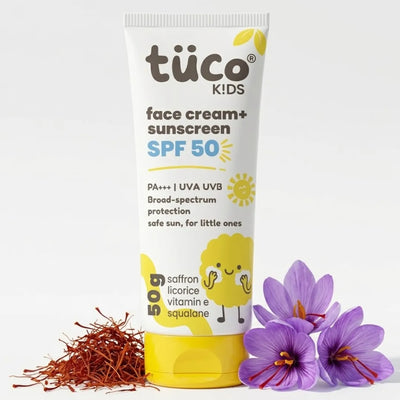
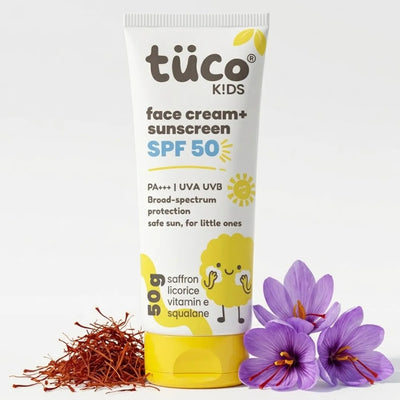
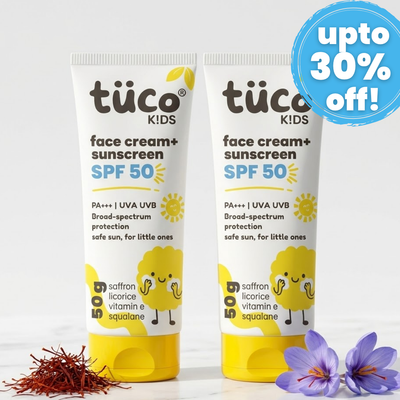
Tuco Kids tip: If your daughter's skin reacts to most sunscreens with stinging, redness, or breakouts, the culprit in most cases is synthetic fragrance, oxybenzone, or alcohol denat — three of the most common contact allergens in adult and baby sunscreen formulas alike. The Tuco Kids Sunscreen SPF 50 (50gm) contains none of these — formulated without fragrance, without oxybenzone, and without alcohol denat specifically for the reactive and sensitive skin of girls aged 3 to 15.
Shop Sunscreen SPF 50 →
What's in This Guide
- Quick Comparison: Tuco Sunscreens for Girls
- Why Girls' Skin Is More Sensitive (Especially During Puberty)
- Ingredients to Avoid in Sunscreen for Sensitive Girls' Skin
- Ingredients to Look For
- Age-by-Age Buying Guide: Best Sunscreen for Girls at Each Stage
- If Your Teen Is Using Acne Treatments: Why SPF 50 Is Non-Negotiable
- Summer and Monsoon: Sunscreen for Active Girls
- How to Patch-Test Sunscreen Correctly
- Building a Sunscreen Habit That Sticks
- Frequently Asked Questions
- Related Reads
Quick Comparison: Tuco Sunscreens for Girls
| Product | Best For | Key Features | Shop |
|---|---|---|---|
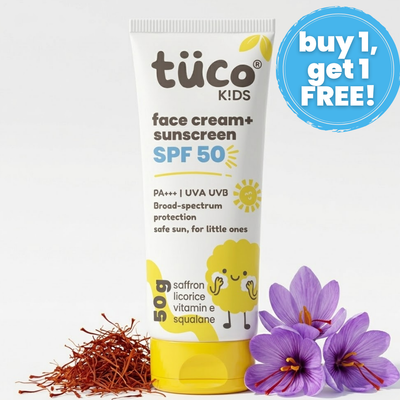
| Sunscreen SPF 50 (50gm) | Sensitive, oily, acne-prone skin · Ages 10–15 · Outdoor-active girls · Girls on acne treatment | SPF 50 PA++++ · No oxybenzone · No synthetic fragrance · No alcohol denat · Non-comedogenic · Oil-free · No white cast on Indian skin · Water-resistant · Saffron Oil + Squalane + Liquorice Root | Shop SPF 50 → |
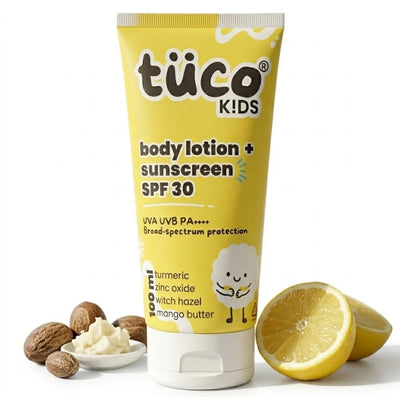
| Sunscreen SPF 30 (30gms) | Normal to sensitive skin · Ages 3–10 · Indoor-heavy school days · Travel and school bag | SPF 30 broad-spectrum · 2-in-1 sunscreen + moisturiser · Lightweight · Compact travel size · Fragrance-free · Paraben-free · Dermatologist-tested from age 3 | Shop SPF 30 → |
Tan Removal Kit |
Complete summer protection · Active outdoor girls · Holidays, sports camps, beach trips |
Bye, Dull Skin Face Wash + Face Cream & Sunscreen SPF 50. Water-resistant SPF 50, SLS-free, paraben-free, PETA certified cruelty-free. |
Shop Kit → |
Why Girls' Skin Is More Sensitive — Especially During Puberty
Sensitive skin in children and teenage girls is not a character trait or a permanent diagnosis — it is a physiological state that changes significantly with age, hormones, and environment. Understanding why skin becomes reactive is the first step to choosing a sunscreen for teenage girls that works rather than worsens the problem.
- The skin barrier is still developing: children's skin is thinner and more permeable than adult skin — the outermost layer (stratum corneum) is less mature, which means both UV radiation and skincare ingredients penetrate more easily. This is why a sunscreen ingredient that causes no reaction in an adult can trigger stinging or redness in a 10-year-old
- Puberty disrupts the skin's natural balance: between ages 10 and 15, rising hormones increase sebum production, alter the skin's pH balance, and make the skin barrier more reactive to external irritants. A girl who had no product sensitivities at age 8 may develop them at age 12 — this is a hormonal change, not a product failure
- Acne treatments increase photosensitivity: teenage girls using AHAs, BHAs, benzoyl peroxide, retinoids, or salicylic acid for acne have significantly more UV-sensitive skin than untreated skin. These actives thin the stratum corneum and increase the speed at which UV radiation causes inflammation. For girls on any acne treatment, SPF 50 is not a recommendation — it is a requirement
- Indian climate compounds sensitivity: high humidity, heat, hard water, and outdoor pollution all act as additional skin stressors that worsen existing sensitivities. A formula that tests fine in a controlled environment may cause reactions when combined with 37°C heat and 85% humidity
- Most "kids" products are actually adult formulas in smaller packaging: many products labelled for children still contain synthetic fragrance, oxybenzone, and alcohol denat at the same concentrations as adult products. These are the three most common causes of sunscreen-related reactions in young and sensitive skin
Ingredients to Avoid in Sunscreen for Sensitive Girls' Skin
This is the most practically useful section for parents choosing a best sunscreen for teenage girl with sensitive or reactive skin — and the section most competitor guides either skip or underexplain.
| Ingredient | Where It Appears | Why to Avoid for Sensitive Skin |
|---|---|---|
| Oxybenzone (Benzophenone-3) | Chemical UV filter in most adult sunscreens | Absorbs through the skin; known contact allergen; causes photoallergic reactions in sensitive and young skin; associated with hormonal disruption |
| Octinoxate (Ethylhexyl Methoxycinnamate) | Chemical UV filter, often paired with oxybenzone | Common cause of contact dermatitis; similar absorption and hormonal concerns to oxybenzone; not appropriate for children's or sensitive skin |
| Synthetic Fragrance ("Parfum") | Almost all mass-market sunscreens and "kids" products | The single most common contact allergen in skincare; a single "fragrance" listing can contain hundreds of undisclosed chemicals; causes stinging, redness, and eczema flares in sensitive skin |
| Alcohol Denat (Denatured Alcohol) | Lightweight or "quick-dry" sunscreen formulas | Strips the skin's natural moisture barrier; causes dryness and tightness that worsens sensitivity; particularly harmful on skin already stressed by acne treatments |
| Avobenzone | UVA-protective chemical filter | Less stable than mineral filters; can break down in UV exposure, causing free radical release; can cause photoallergic reactions in some sensitive skin types |
| Artificial Dyes and Colorants | Some "fun" or brightly packaged kids' sunscreens | Serve no protective function; common causes of contact dermatitis in children; particularly problematic for skin with existing eczema or psoriasis |
| Essential Oils (Lavender, Citrus, Lemongrass) | Natural and "clean" beauty sunscreens | Counterintuitively, natural essential oils are among the most reactive ingredients for sensitive skin; lavender in particular is a documented contact allergen and should be avoided on children's and sensitive skin |
Tuco Kids Sunscreen SPF 50 and SPF 30 contain none of the above. Both are free from oxybenzone, octinoxate, synthetic fragrance, alcohol denat, and artificial dyes — the complete avoid list for sensitive girls' skin.

Ingredients to Look For in Sunscreen for Sensitive Skin
The positive list for best sunscreen for kids and teenage girls with sensitive skin is shorter and more specific than the avoid list:
- Zinc oxide: the gold-standard mineral UV filter for sensitive skin — sits on the skin surface without being absorbed, deflects UV rays physically, and has natural anti-inflammatory properties that can reduce redness around existing irritation. The preferred UV filter for girls under 12, and for any age with genuinely sensitive or reactive skin
- Titanium dioxide: the secondary mineral UV filter, often paired with zinc oxide. Also sits on the skin surface, extremely gentle, and rarely causes reactions in even the most reactive skin types
- Squalane: a lightweight, non-comedogenic moisturising ingredient that mimics the skin's own natural oils — hydrates without adding oiliness or blocking pores. Present in Tuco's SPF 50 formula for exactly this reason
- Saffron Oil (Crocus sativus): anti-inflammatory and antioxidant — helps calm reactive skin while providing antioxidant protection against the free radicals generated by UV exposure. A key active in Tuco's sunscreen formula
- Liquorice Root Extract (Glycyrrhiza glabra): natural UV protector and anti-inflammatory; reduces redness and soothes irritated skin; helps prevent UV-induced dark spots on reactive and sensitive skin
- Hyaluronic acid: humectant that draws moisture into the skin without any irritation risk; compatible with all sensitive skin types including eczema-prone skin
- Ceramides: help repair and strengthen the damaged skin barrier that underlies most cases of skin sensitivity; particularly beneficial for eczema-prone skin
Age-by-Age Buying Guide: Best Sunscreen for Girls at Each Stage
One of the most consistently missing pieces in competitor guides is age-specific differentiation. The best sunscreen for a 15-year-old girl is genuinely different from what's right for a 7-year-old or a 10-year-old — skin physiology, oil production, and sensitivity patterns all shift significantly across this age range.
Ages 3–9: Gentle Protection, Mineral Priority
- Skin at this age: thin, highly permeable, very low sebum production, most sensitive to ingredient absorption. Any chemical UV filter has a proportionally higher absorption rate than in older children
- Formula needed: mineral or mineral-hybrid formula; fragrance-free; paraben-free; dermatologist-tested specifically for this age group
- SPF: minimum SPF 30 for school days; SPF 50 for outdoor activity lasting 30+ minutes
- Product: the Sunscreen SPF 30 (30gm) is the right daily formula at this age — lightweight 2-in-1 that provides protection and nourishment without overloading young skin
Ages 10–12: Transition Phase — Watch for New Sensitivities
- Skin at this age: hormonal changes beginning; early sebum increase; skin may be developing sensitivities it did not previously have; first signs of uneven tone from cumulative UV exposure
- Formula needed: still fragrance-free; non-comedogenic as sebum production begins; lightweight — cream textures that worked at age 7 may feel too heavy by age 11
- SPF: SPF 50 is now the recommended daily standard given the UV levels Indian girls face during school and outdoor activity
- Watch for: new reactions to products used previously without issue — this is a hormonal shift, not a product change, and means it's time to reassess the formula
Ages 13–15: Hormonal Peak — Sensitive and Oily Skin Together
- Skin at this age: hormones at peak activity; oil production highest; acne risk highest; skin most reactive to irritants; simultaneously more sensitive AND more oily — the most challenging combination to formulate for
- The best sunscreen for teenage girl at this age must be non-comedogenic AND fragrance-free AND lightweight — simultaneously addressing the oil and the sensitivity, which rules out most "sensitive skin" sunscreens that are rich and nourishing rather than lightweight
- SPF: SPF 50 mandatory, particularly PA++++ UVA rating — UVA drives hyperpigmentation and darkens post-acne marks rapidly at this hormonal stage
Ages 15+: Stabilising but Still Reactive
- Skin at this age: hormones beginning to stabilise in many girls; skin texture improving; but sensitivity to chemical UV filters and fragrance may have become established during puberty and persist into adulthood
- The best sunscreen for a 15-year-old girl is typically an SPF 50 lightweight fluid or gel formula that is non-comedogenic and free from oxybenzone and fragrance — the same criteria as the 13–15 range, but this is also when teenagers can be introduced to lightweight antioxidant actives (like Vitamin C) paired with SPF if acne marks or UV-induced dullness is a concern
- Habits formed at 15 typically persist into the 20s — getting the right formula at this age is the most impactful long-term skin investment
For girls aged 10–15 with sensitive skin: The Sunscreen SPF 50 (50gm) is the best sunscreen for girls with oily, sensitive, or acne-prone skin — SPF 50 PA++++, non-comedogenic, oil-free, and free from the seven ingredients most commonly responsible for sunscreen reactions in teenage skin. No white cast on Indian skin tones. Dermatologist-tested from age 3.
Shop Sunscreen SPF 50 →If Your Teen Is Using Acne Treatments: Why SPF 50 Is Non-Negotiable
This is the single most important section for parents of teenage girls on acne treatment — and one that no general sunscreen guide adequately covers. If your daughter uses any of the following, her skin is significantly more UV-sensitive than untreated skin:
- AHA exfoliants (glycolic acid, lactic acid, mandelic acid)
- BHA exfoliants (salicylic acid — including face washes, toners, and spot treatments)
- Benzoyl peroxide (BPO) in any concentration
- Topical retinoids or retinol
- Niacinamide at higher concentrations (5%+)
- Prescription acne medications (adapalene, tretinoin, isotretinoin)
- Why these treatments increase photosensitivity: AHAs, BHAs, and retinoids work by thinning the stratum corneum (the outer protective layer of skin) — the same layer that provides a partial natural barrier against UV radiation. Thinning this layer accelerates how quickly UV causes inflammation, redness, and post-inflammatory hyperpigmentation
- The consequence of insufficient SPF on treatment skin: unprotected sun exposure on skin using acne treatment actives will darken post-acne marks significantly, worsen existing redness and irritation, and in many cases reduce the effectiveness of the active ingredient itself
- The minimum SPF for treatment skin is SPF 50 PA++++: not SPF 30, not "any sunscreen". PA++++ is the highest UVA rating available and directly addresses the pigmentation-driving rays that worsen post-acne marks
- Apply sunscreen as the absolute last step in the morning routine — after cleanser, after treatment, after moisturiser. Never mix sunscreen with other products; always apply as a separate, final layer
The Tuco Kids Sunscreen SPF 50 (50gm) is appropriate for skin on acne treatment — it contains no ingredients that interfere with common acne actives and is non-comedogenic, meaning it does not add pore-clogging load on top of skin already being treated for breakouts.
Summer and Monsoon: Sunscreen for Active Girls
Indian summers and the monsoon season create specific sun protection challenges for girls that most guides don't address — particularly around swimming, sweat, and the specific UV risk of India's climate.
Summer (March–June): Heat + UV + Sweat
- Increase reapplication frequency: in Indian summer heat (35°C+), sweat degrades sunscreen significantly faster than in temperate conditions. Reapply every 90–120 minutes for outdoor activity in summer rather than the standard 2-hour interval
- Water-resistant formula is not optional for summer: water-resistance means the formula maintains efficacy for 40–80 minutes in water — after which reapplication is required regardless. For girls at swimming pools, lakes, or beach trips, this means reapplying immediately after towelling off
- Pool rashes and sunscreen: chlorine in swimming pools is a contact irritant for sensitive skin — it strips the skin barrier and makes it more reactive to everything, including sunscreen. Use a minimal-ingredient, fragrance-free SPF formula before and after pool sessions, and rinse off chlorine water thoroughly before reapplying
- The Summer Skincare Kit covers all three scenarios: the Summer Skincare Kit bundles SPF 50 sunscreen with the cooling Magic Gel (for post-sun soothing and minor irritation) and a Body Mist (for staying fresh through sweat) — the complete summer protection routine for active girls aged 3 to 15
Monsoon (July–September): UV + Humidity
- Cloud cover does not mean UV safety: up to 80% of UV radiation penetrates cloud cover — a rainy or overcast day carries almost the same UV risk as a sunny one. Skipping sunscreen on rainy days is one of the most common and most damaging mistakes Indian parents and teenagers make
- High humidity means sunscreen slides off faster: sweat and humidity accelerate degradation of the SPF layer. In monsoon conditions, a water-resistant formula is as important as in summer
- Sensitive skin alert during monsoon: humidity means skin doesn't dry fully between washings, increasing the risk of fungal or bacterial secondary skin issues on already-sensitised skin. Use a lightweight, non-occlusive formula during monsoon — avoid heavy creams that trap moisture on the skin surface
For summer and active outdoor girls: The Tan Removal Kit —Bye, Dull Skin Face Wash + Face Cream & Sunscreen SPF 50 — is the complete 2-step summer protection routine for girls aged 3 to 15. Water-resistant SPF 50, after-sun soothing, and all-day freshness in one kit. SLS-free, paraben-free, PETA certified cruelty-free.
Shop Tan Removal Kit →How to Patch-Test Sunscreen Correctly
This is the most consistently skipped step — and for girls with sensitive skin, it is the single most important step before committing to a new sunscreen. Here is the correct protocol:
- Choose the test area: apply a small amount (pea-sized) to the inner wrist or the jawline — skin at these locations behaves similarly to facial skin and will show reactions in the same timeframe. Do not test on the inner elbow — it is less reactive and less predictive of facial responses
- Leave it on: do not wash off for 24 hours. Most contact reactions from fragrances and chemical UV filters show up between 12 and 24 hours — reactions that appear within minutes are typically immediate irritant responses rather than contact allergies
- What to look for at 24 hours: redness, itching, swelling, small bumps, or hives at the test site indicate a reaction. If none of these appear, the product is likely safe for full-face application
- Then test on the face: apply to one side of the face only for 2–3 days before full-face use. This gives a final check before committing to a daily product
- Patch-test separately from treatment products: if your daughter uses an acne treatment product, patch-test the new sunscreen on days when the treatment is not being applied to the test area — this isolates the sunscreen as the variable
- Repeat patch testing when switching products: a formulation change in a trusted brand can introduce new ingredients. Always patch-test again when switching to a new bottle of any sunscreen, even the same product line
Building a Sunscreen Habit That Sticks
For girls with sensitive skin, sunscreen compliance is particularly low — because their history with sunscreen is often negative (breakouts, stinging, greasiness from wrong formulas). Here is how to rebuild the habit correctly:
- Start with the right formula first: the most common reason girls with sensitive skin give up on sunscreen is that they tried an unsuitable formula and concluded sunscreen doesn't work for them. Starting with a formula specifically designed for sensitive young skin — and patch-testing before committing — prevents this narrative from forming
- Keep it in the same place every morning: sunscreen sitting next to the face wash or toothbrush gets used; sunscreen in a drawer does not. Physical visibility is the most reliable predictor of whether a teen uses a product consistently
- Apply before getting dressed — not at the door: applying sunscreen at the door creates two problems — not enough time for it to set, and the 15-minute window before outdoor exposure is missed. Building the habit into the post-face-wash step of the morning routine (before dressing) is the most reliable placement
- Keep a small tube in the school bag: the SPF 30 (30gm) fits in any school bag pencil case and makes midday reapplication — which is otherwise almost never done by teenagers — a practical option for girls with after-school sports or outdoor activity
- Connect SPF to something the teen already cares about: for girls concerned about post-acne marks or uneven skin tone — both extremely common in teenage girls — framing daily SPF 50 as the most effective step for preventing those marks from darkening is the most persuasive motivation available. It is also simply true

Frequently Asked Questions
What is the best sunscreen for teenage girl with sensitive skin in India?
The best sunscreen for teenage girl with sensitive skin must be free from the seven most common sensitisers: oxybenzone, octinoxate, synthetic fragrance, alcohol denat, avobenzone, artificial dyes, and essential oils. It must be SPF 50 with PA++++ UVA protection, non-comedogenic, and formulated without white cast on Indian skin tones. Tuco Kids Sunscreen SPF 50 meets all of these criteria and is dermatologist-tested on Indian girls' skin from age 3 to 15.
What is the best sunscreen for a 15-year-old girl?
At 15, skin is typically still oily to combination with residual hormonal sensitivity — the best sunscreen for a 15-year-old girl is a lightweight, non-comedogenic SPF 50 that is fragrance-free and free from oxybenzone. If she is using any acne treatment products (salicylic acid, benzoyl peroxide, retinol), SPF 50 PA++++ is non-negotiable — these treatments significantly increase UV sensitivity and the speed at which sun exposure darkens post-acne marks. The Tuco Kids SPF 50 is appropriate for this age and formulated specifically for Indian teenage skin.
Is SPF 30 or SPF 50 better for teenage girls with sensitive skin?
SPF 50 is the better choice for teenage girls with sensitive skin, particularly in India. The reasoning: sensitive skin is often simultaneously being treated with acne actives that increase photosensitivity; SPF 50's PA++++ UVA rating prevents UV from darkening post-acne marks and reactive skin pigmentation; and India's UV Index of 8–11 year-round means every outdoor exposure requires strong protection. SPF 30 is appropriate for mostly-indoor days. Keep SPF 30 (30gm) in the school bag for convenient midday reapplication.
Can sunscreen cause skin reactions in sensitive teenage girls?
Yes — if the formula contains synthetic fragrance, oxybenzone, alcohol denat, or essential oils. These are the four most common sunscreen contact allergens in teenage skin. The sunscreen itself is not the problem; the specific ingredients in the formula are. Switching to a fragrance-free, oxybenzone-free formula like Tuco Kids SPF 50 resolves most sunscreen-related reactions in sensitive teenage girls. Always patch-test any new sunscreen on the inner wrist for 24 hours before full-face application.
Should girls with sensitive skin use mineral or chemical sunscreen?
Mineral sunscreen — using zinc oxide and titanium dioxide — is the safer starting point for sensitive and reactive skin. Mineral UV filters sit on the skin surface without being absorbed, dramatically reducing the chance of contact irritation or photoallergic reactions. Chemical UV filters like oxybenzone and octinoxate are absorbed through the skin — on sensitised teenage skin this can cause stinging, redness, or delayed allergic reactions. Tuco Kids SPF 50 uses a mineral and natural-hybrid formula that provides broad-spectrum protection without chemical UV filters.
What should girls avoid in sunscreen if they have sensitive or acne-prone skin?
The complete avoid list for sensitive and acne-prone girls' skin: oxybenzone, octinoxate, synthetic fragrance (listed as "parfum"), alcohol denat, avobenzone, artificial dyes, essential oils (lavender, citrus, lemongrass), heavy silicones, coconut oil, lanolin, and isopropyl myristate. The last four are the most common comedogenic ingredients in sunscreens that cause breakouts. All Tuco Kids sunscreens are free from every ingredient on this list.
How often should girls reapply sunscreen during summer in India?
Every 2 hours during outdoor activity — every 90 minutes in intense Indian summer heat (35°C+) when sweat degrades the SPF layer faster. Reapply immediately after swimming, towelling off, or heavy sweating regardless of how recently it was applied. Water-resistant formulas maintain efficacy for 40–80 minutes in water, not indefinitely. For girls at summer camps, sports practice, or outdoor activities, the Summer Skincare Kit includes everything needed for full-day summer protection.
Is the Tuco Kids sunscreen safe for girls using acne treatment products?
Yes. Tuco Kids Sunscreen SPF 50 contains no ingredients that interfere with common acne treatments (salicylic acid, benzoyl peroxide, niacinamide, retinoids). It is non-comedogenic — meaning it does not add pore-clogging load on top of skin being treated for breakouts. It is applied as the last step in the morning routine, after all treatment products have been applied and absorbed. For girls on prescription acne medication (adapalene, tretinoin, isotretinoin), consult your dermatologist before adding any new product to the routine.
Can girls with eczema use sunscreen?
Yes — and they need it more urgently than girls without eczema, because eczema-damaged skin barrier absorbs UV radiation more rapidly and eczema flares are frequently triggered or worsened by sun exposure. For girls with eczema, the formula requirements are: 100% mineral UV filters only (zinc oxide and titanium dioxide), completely fragrance-free, no alcohol denat, no preservatives that are known eczema triggers (methylisothiazolinone, formaldehyde-releasing preservatives). Always patch-test any new sunscreen on a small, non-affected area of skin for 48 hours before applying near affected areas. Consult a paediatric dermatologist for children with moderate to severe eczema before introducing new topical products.
Related Reads
- Which SPF Sunscreen Is Best for Teenage Girls? Guide for Oily, Dry or Sensitive Skin
- Best Sunscreen for Kids in India: SPF 30 vs SPF 50 — What Really Protects Your Child
- Best Sunscreen for Kids in India 2026: No White Cast, Safe from Age 2
- Best Sunscreens for Girls of Every Skin Type
- Hydration + Protection: Best Sunscreens for Teenage Girls with Dry Skin
- The Best Sunscreens for Kids Aged 10 and Up: Top Picks for Ultimate Protection