



Best Sunscreens for Kids: Gentle, Safe, and Dermatologist-Approved Protection
India sits close to the equator, which means its UV Index stays between 8 and 11 for most of the year — not just in summer. Every school commute, outdoor sports period, and afternoon in the playground accumulates UV exposure that, without protection, adds up to tanning, UV-induced skin damage, and skin concerns that become much harder to reverse with age. Yet most parents either skip sunscreen entirely, use the wrong SPF for their child's age, or apply it incorrectly — meaning the protection never actually reaches the level on the bottle. This guide covers everything: which is the best sunscreen for kids in India by age, how to apply it correctly, what ingredients to avoid, and what the competitors don't tell you about making sunscreen a habit your child will actually keep.
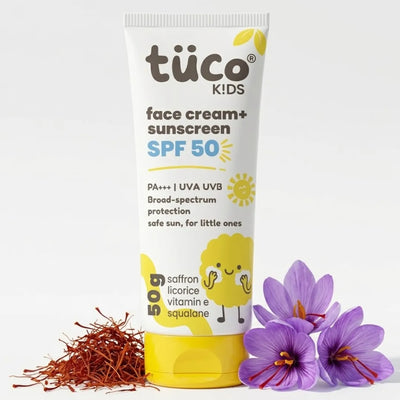
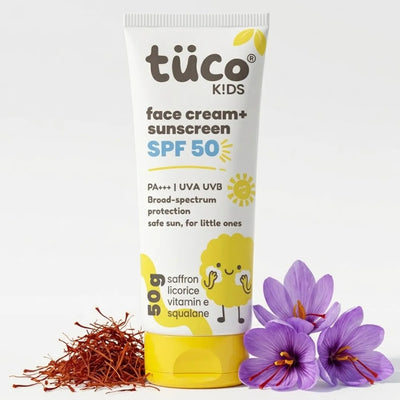
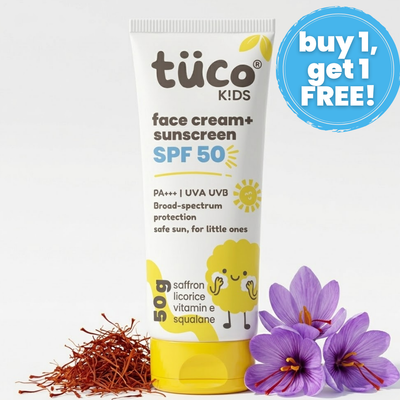
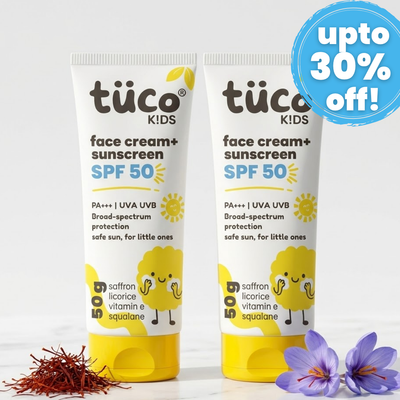
Tuco Kids tip: The number one reason children stop wearing sunscreen is texture — thick, greasy formulas feel uncomfortable in India's humidity and heat. The Tuco Kids Sunscreen SPF 50 is the best sunscreen for kids dermatologist recommended for Indian conditions — lightweight, non-greasy, no white cast on Indian skin tones, and dermatologist-tested from age 3. Apply 15 minutes before stepping out for full protection.
Shop Kids Sunscreen SPF 50 →
What's in This Guide
- Quick Comparison: Tuco Kids Sunscreen Products
- Why Kids Need Sunscreen Every Day in India
- Mineral vs Chemical Sunscreen: What Indian Parents Need to Know
- Ingredients to Avoid in Kids' Sunscreen
- Age-by-Age Guide: Which Sunscreen Is Best for Kids in India
- SPF 30 vs SPF 50: Which Does Your Child Need?
- How to Apply Sunscreen on Kids Correctly
- The White Cast Problem: Why It Matters on Indian Skin Tones
- Beyond Sunscreen: Completing Your Child's Sun Safety Routine
- Frequently Asked Questions
- Related Reads
Quick Comparison: Tuco Kids Sunscreen Products
| Product | Best For | Key Features | Shop |
|---|---|---|---|
| Sunscreen for Kids SPF 50 (50gm) | Active outdoor kids, summer, sports, beach days · Ages 3+ · Daily use in high-UV months | SPF 50 broad-spectrum · PA++++ UVA protection · No white cast · Non-greasy · Dermatologist-tested · Safe from age 3 | Shop SPF 50 → |
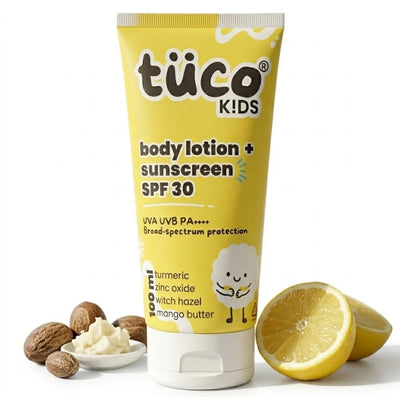
| Sunscreen for Kids SPF 30 (30gms) | Daily school routine · Indoor-heavy days · Ages 3+ · Lighter formula for everyday use | SPF 30 broad-spectrum · Lightweight texture · Easy to apply · Ideal for regular school days with limited direct outdoor exposure | Shop SPF 30 → |
| Summer Skincare Kit | Complete summer protection bundle · Holidays, beach trips, summer camp · Multi-product routine | Sunscreen + complementary summer skincare products · Complete protection routine for summer months · Value bundle for active kids | Shop Summer Kit → |
Why Kids Need Sunscreen Every Day in India
Most parents apply sunscreen only on beach trips or holidays. This is the single most common and most consequential sun protection mistake Indian parents make. Here is why daily sunscreen matters specifically in India:
- India's UV Index stays dangerously high year-round: unlike European climates where UV drops significantly in winter, India's proximity to the equator means UV radiation levels of 8–11 are common even in November and December, particularly in southern and western cities. UV damage happens on these days just as much as in June
- Children's skin is more vulnerable than adults': children have thinner skin, less melanin (the natural UV-blocking pigment), and DNA repair mechanisms that are still developing. The same UV exposure causes more damage faster in a child than in an adult — and cumulative sun exposure in childhood is directly linked to skin health outcomes in adulthood
- School exposure is significant and daily: the morning school commute, outdoor assembly, sports periods, lunch breaks, and the afternoon commute home add up to an hour or more of direct UV exposure every single school day, every week, all year. This is the daily UV damage accumulation that a good kids sunscreen in India needs to address
- Cloudy days are not sun-safe days: up to 80% of UV radiation penetrates cloud cover. A grey or overcast day in India is not a reason to skip sunscreen for your child
- UV damage is cumulative and irreversible: each episode of unprotected sun exposure adds to a lifetime total of UV damage. Unlike other types of skin damage, UV damage does not fully repair itself — it accumulates. Starting daily sunscreen use in childhood builds the most important protection of all: habit
Mineral vs Chemical Sunscreen: What Indian Parents Need to Know
This is one of the most common questions in competitor content and one the original blog didn't address at all. The answer determines which product formula is appropriate for your child's age and skin type.
| Mineral Sunscreen | Chemical Sunscreen | |
|---|---|---|
| How it works | Sits on the skin's surface and physically reflects UV rays away — like a mirror | Absorbs into the skin and converts UV rays into heat, which is then released |
| Active ingredients | Zinc oxide, titanium dioxide | Oxybenzone, avobenzone, octinoxate, octisalate |
| Best for | Younger children (under 6), sensitive skin, eczema-prone skin | Older children and teens who need lightweight, no-white-cast formulas |
| White cast on Indian skin? | Can leave a visible white or grey cast — significant issue on Indian skin tones | Usually no white cast — blends more easily on darker skin tones |
| Safety concern | No known safety concerns for children — preferred by dermatologists for young children | Oxybenzone is a known endocrine disruptor — avoid in children's formulas |
| Tuco recommendation | Tuco Kids sunscreens use mineral and hybrid formulas optimised for Indian skin tones — broad-spectrum protection without the white cast that is the primary compliance barrier for Indian children | |
The hybrid approach: the most practical option for school-going Indian children is a hybrid mineral-chemical formula that combines the safety of mineral UV filters with the lightweight, no-white-cast finish of chemical formulas. This is what makes the Tuco Kids Sunscreen SPF 50 the best sunscreen for kids dermatologist recommended for Indian children — it delivers mineral-level safety without the white cast that causes children to resist wearing it.
Ingredients to Avoid in Kids' Sunscreen
Not every bottle labelled "kids sunscreen" is actually formulated for children. These are the ingredients competitor dermatologist guides flag as problematic in children's sunscreens — and that parents should check for on any label before buying:
- Oxybenzone: the most commonly flagged chemical UV filter in paediatric dermatology literature. It absorbs through the skin, has been detected in blood, urine, and breast milk, and has known endocrine-disrupting properties at high concentrations. Avoid in all sunscreens used on children under 12
- Octinoxate (ethylhexyl methoxycinnamate): another chemical UV filter with similar absorption and hormonal disruption concerns. Frequently found in mass-market adult sunscreens sold to families
- Synthetic fragrance (listed as "parfum"): the most common contact allergen in skincare products for children. A single "fragrance" listing can contain hundreds of undisclosed chemicals — any of which can trigger skin reactions in sensitive young skin
- Parabens (methylparaben, propylparaben): preservatives linked to hormonal disruption at cumulative doses. The EU has restricted several parabens specifically in products used by children
- Alcohol denat: a drying agent that strips the skin's natural moisture barrier — particularly problematic in children's sunscreens that are intended for daily use in India's already-dehydrating heat
- Artificial dyes and colorants: serve no functional purpose in sunscreen and are common triggers for contact dermatitis in children with sensitive skin
Tuco Kids sunscreens are free from all of the above — no oxybenzone, no parabens, no synthetic fragrance, no artificial dyes. Dermatologist-tested specifically for Indian children's skin from age 3.

Age-by-Age Guide: Which Sunscreen Is Best for Kids in India
One of the biggest gaps in most sunscreen guides — including the original version of this blog — is treating all children as a single group. Age-appropriate sunscreen is one of the most frequently searched topics by Indian parents, and for good reason: the right formula for a toddler is genuinely different to what a 7-year-old or a 13-year-old needs.
Under 6 months — No Sunscreen
- Paediatric guidelines universally recommend against applying sunscreen to babies under 6 months of age — their skin absorbs ingredients too readily and is too sensitive for any current sunscreen formulation
- Sun protection at this age means physical barriers: shade, a pram canopy, lightweight long sleeves, and a wide-brimmed hat
- Avoid direct midday sun (10am–4pm) entirely for infants this young
6 Months to 2 Years — Mineral-Only, Minimal Application
- From 6 months, a 100% mineral sunscreen (zinc oxide or titanium dioxide) on exposed areas is appropriate when sun exposure cannot be avoided
- Physical barriers (clothing and shade) remain the primary protection at this age — sunscreen is supplemental
- Apply only to face, hands, and any other exposed areas — not full body coverage as for older children
- Choose fragrance-free, hypoallergenic, and paraben-free formulas only
Ages 3–6 — Daily Sunscreen Begins
- This is the ideal age to establish the daily sunscreen habit — children at this age adapt to routines much more readily than teenagers
- The best sunscreen for kids aged 3–6 is a lightweight SPF 30 for regular school days with limited direct outdoor exposure
- For outdoor play sessions, park visits, or summer days, step up to SPF 50
- Apply to face, neck, hands, and any areas not covered by clothing — ears and the back of the neck are commonly missed at this age
Ages 7–10 — Increase SPF, Build the Habit
- School-going children aged 7–10 have significantly more daily UV exposure than younger children — more outdoor play, longer commutes, sports periods, and school trips
- The best sunscreen for a 7-year-old in India is a broad-spectrum SPF 50 applied every morning before school, with a reapplication option (small tube in the school bag) for days with extended outdoor activity
- At this age, involve your child in applying their own sunscreen under supervision — ownership of the habit dramatically increases compliance as they grow older
Ages 11–15 — Higher UV Exposure, Skin Type Awareness
- Pre-teens and teenagers have the highest average daily UV exposure of any age group due to sports, outdoor social activities, and longer unsupervised time outdoors
- Skin type now starts to matter: oily or acne-prone teenage skin needs a non-comedogenic formula that won't clog pores. Dry skin needs one with moisturising actives. See the full guide for teenage skin types here
- SPF 50 is the standard at this age given the activity level and India's UV conditions
Complete summer protection for all ages: The Summer Skincare Kit bundles Tuco's sunscreen with complementary summer skincare products — the complete routine for active kids during peak UV months. Ideal for summer holidays, beach trips, and sports camps.
Shop Summer Skincare Kit →
SPF 30 vs SPF 50: Which Does Your Child Need?
This is the most-searched sunscreen question for children in India, and most guides give an oversimplified answer. Here is the complete picture — because the right answer genuinely depends on how your child spends their day.
| SPF 30 | SPF 50 | |
|---|---|---|
| UVB ray blockage | Blocks approximately 97% of UVB rays | Blocks approximately 98% of UVB rays |
| Best situation | Indoor-heavy school days · Limited outdoor exposure · Cloudy days | Any outdoor activity lasting 30+ minutes · Sports, sports days · Beach / holiday · Summer months |
| Indian UV context | Adequate for regular school days where most time is spent indoors | Recommended standard for India's UV Index of 8–11 — the extra 1% matters at this UV intensity |
| Reapplication frequency | Every 2 hours during outdoor activity | Every 2 hours during outdoor activity (same — higher SPF does not mean less frequent reapplication) |
| Tuco product | Sunscreen SPF 30 (30gms) | Sunscreen SPF 50 (50gms) |
The practical recommendation for most Indian families: keep SPF 50 as the default standard for school-going children in India. The difference between SPF 30 and SPF 50 is small in a lab, but India's sustained high-UV conditions mean erring toward the higher protection is always the better choice. The SPF 30 is appropriate as a lighter daily option for children who spend most of their school day indoors.
For outdoor-active kids: The Sunscreen for Kids SPF 50 (50gm) is the best kids sunscreen in India for children who play sports, attend outdoor school events, or spend time outdoors in peak UV hours. Broad-spectrum PA++++ protection, no white cast, dermatologist-tested for ages 3+.
Shop Sunscreen SPF 50 →How to Apply Sunscreen on Kids Correctly
Even the best sunscreen for kids delivers only a fraction of its labelled SPF if applied incorrectly. Studies consistently show that most people apply 25–50% of the recommended amount — which means their effective protection is roughly half the number on the bottle. Here is the correct approach:
- Apply the right amount — the two-finger rule: squeeze sunscreen along the length of your index and middle finger for the face and neck combined. This is the minimum amount needed to achieve the SPF on the label. A pea-sized amount — the most common error — delivers far less than SPF 30 or SPF 50 in real use
- Apply 15–20 minutes before going outdoors: mineral UV filters need time to bind properly to the skin before they become fully effective. Apply before getting dressed — not at the front door as you're leaving
- Cover commonly missed areas: ears (especially the tops), the back of the neck, hands, feet if sandals are worn, and the V of the chest if the collar is open. These are the areas that consistently show tan lines in children because they're skipped during application
- Reapply every 2 hours during outdoor activity: no sunscreen — regardless of SPF or "all-day protection" claims — maintains its stated efficacy for more than 2 hours of active outdoor exposure. Keep a small tube of Sunscreen SPF 30 in the school bag for midday reapplication on days with extended outdoor activity
- Reapply immediately after swimming or heavy sweating: water-resistant formulas maintain efficacy for 40–80 minutes in water — after this point, reapplication is required regardless of how recently it was applied
- Don't rely on SPF in makeup, moisturiser, or tinted products: the layers are too thin to deliver the labelled SPF. Sunscreen must be applied as a standalone product at the correct quantity
The White Cast Problem: Why It Matters on Indian Skin Tones
White cast — the visible grey or white film that many mineral sunscreens leave on darker skin tones — is the single most common reason Indian children (and their parents) stop using sunscreen consistently. This is not a vanity concern: it is a compliance barrier that directly affects how much UV protection children actually receive day to day.
- Why it happens: pure mineral sunscreens (zinc oxide and titanium dioxide) are white pigments that sit on the skin's surface — on lighter European skin tones, they blend in adequately; on Indian, South Asian, and other darker skin tones, they leave a visibly grey or ashy residue that looks unnatural and is deeply unpopular with school-going children who are aware of their appearance
- Why it matters for compliance: dermatologists consistently note that the best sunscreen is the one the child will actually wear every day. A formula that leaves a white cast on Indian skin will be resisted by children within the first week, regardless of how effective it is in theory
- The solution: hybrid mineral-chemical formulas, or chemical formulas with micronised mineral filters, deliver broad-spectrum protection without leaving a visible white residue on Indian skin tones. This is the specific formulation advantage of Tuco Kids sunscreens — best kids sunscreen India parents and children will actually use consistently
- Which sunscreen is best for kids in India: for Indian skin tones, look specifically for "no white cast" on the product label — and test it on the inner wrist before full-face application if switching from a mineral-only formula
Beyond Sunscreen: Completing Your Child's Sun Safety Routine
Competitor content consistently covers this and the original blog did not — sunscreen is necessary but not sufficient for complete sun protection. Here is what the complete routine looks like for Indian children:
- Timing: UV radiation is most intense between 10am and 4pm in India. Wherever possible, plan outdoor activities (sports sessions, playdates, holidays) before 10am or after 4pm. For school-going children this isn't always controllable, which is why consistent daily sunscreen is non-negotiable
- Protective clothing: lightweight, tightly woven fabrics that cover arms and legs are as effective as sunscreen on covered areas — and don't need reapplication. UPF-rated sun-protective swimwear is especially valuable for children who swim regularly
- Hats: a wide-brimmed hat (at least 7.5cm brim all around) protects the face, ears, and neck — areas that sunscreen frequently misses because children don't hold still during application. Caps with a forward brim only protect the forehead and leave ears and the back of the neck exposed
- Sunglasses with UV400 protection: children's eyes are more susceptible to UV damage than adults' — the lens of a child's eye transmits significantly more UV to the retina. Wrap-around UV400 sunglasses are recommended for any extended outdoor activity
- The complete summer bundle: the Summer Skincare Kit builds sunscreen into a complete summer protection routine — everything your child needs for active outdoor months in one kit
Frequently Asked Questions
Which sunscreen is best for kids in India?
The best sunscreen for kids in India must meet five criteria specific to Indian children: SPF 50 with PA++++ UVA protection (for India's UV Index of 8–11); a lightweight, non-greasy formula that children will actually wear without resistance; no white cast on Indian skin tones; free from oxybenzone, parabens, and synthetic fragrance; and dermatologist-tested specifically for children's skin from age 3. Tuco Kids Sunscreen SPF 50 was formulated and tested specifically for Indian children and meets all five criteria.
Is SPF 30 or SPF 50 better for kids in India?
SPF 50 is the recommended standard for children in India, particularly for outdoor activity lasting more than 30 minutes. India's UV Index (8–11 year-round) means the extra protection of SPF 50 is worth the small difference in formula weight. SPF 30 is appropriate for school days where most time is spent indoors with limited direct exposure. The Tuco Kids Sunscreen SPF 30 is ideal for this; the SPF 50 for active outdoor days.
What is the best sunscreen for a 7-year-old in India?
For a 7-year-old in India — who has outdoor school activities, PE, and playtime daily — a broad-spectrum SPF 50 in a lightweight, no-white-cast formula is the right choice. The best sunscreen for a 7-year-old in India must be non-greasy (so they won't resist wearing it), tear-free (so it doesn't sting if it runs into eyes during sports), and free from oxybenzone and synthetic fragrance. Tuco Kids Sunscreen SPF 50 meets all of these requirements and is dermatologist-tested from age 3.
What is the best sunscreen for toddlers in India?
For toddlers under 2, paediatric guidelines recommend physical barriers as the primary protection — shade, wide-brimmed hats, and lightweight long sleeves — with sunscreen used only on unavoidably exposed areas. From 6 months, a 100% mineral (zinc oxide or titanium dioxide) fragrance-free formula applied only to the face, neck, and hands is appropriate. Physical barriers remain the priority at this age. From age 3 onwards, a daily lightweight formula like Tuco Kids Sunscreen SPF 30 or SPF 50 is safe and recommended.
Should kids wear sunscreen to school every day?
Yes — every day, regardless of weather. UV exposure accumulates on cloudy school days just as much as on sunny ones; up to 80% of UV radiation penetrates cloud cover. The school commute, morning assembly, sports period, and afternoon commute together add up to meaningful daily UV exposure. A morning application of kids best sunscreen in India before leaving home is sufficient for most school days; keep a small tube in the school bag for days with extended outdoor activity.
Is mineral sunscreen better than chemical sunscreen for children?
For children under 6 or those with very sensitive or eczema-prone skin, mineral sunscreens (zinc oxide, titanium dioxide) are the dermatologist-preferred choice — they sit on the skin surface rather than being absorbed, and avoid concerns about ingredients like oxybenzone. For older children and teenagers, a hybrid mineral-chemical formula provides the same safety benefits with a lighter, more compliant texture and no white cast on Indian skin tones — making it practically the better choice for daily use.
How much sunscreen should I apply on my child?
More than most parents expect. Use the two-finger rule: squeeze sunscreen along the full length of your index and middle finger for the face and neck combined. For the body, approximately one tablespoon per limb is the correct amount. Most parents apply 25–50% of what's actually needed — meaning their child's effective SPF is roughly half the number on the bottle, regardless of how good the formula is.
Can I use adult sunscreen on my child?
Technically, adult sunscreens that are mineral-based and fragrance-free can be used on children aged 3 and above — but most adult formulas contain synthetic fragrance, oxybenzone, or alcohol denat that are not appropriate for children's more sensitive skin. Children's formulas like Tuco Kids Sunscreen SPF 50 are specifically tested for children's skin pH, sensitivity levels, and Indian climate conditions — and are the safer, more appropriate choice for regular daily use on school-going children.
Related Reads
- How to Remove Tan from Kids' Face: Gentle Remedies Parents Trust
- Best Sunscreen for Kids in India: SPF 30 vs SPF 50 — What Really Protects Your Child
- Best Sunscreen for Kids in India 2026: No White Cast, Safe from Age 2
- Which SPF Sunscreen Is Best for Teenage Girls? Choosing the Right SPF for Oily, Dry or Sensitive Skin
- The Best Sunscreens for Kids Aged 10 and Up: Top Picks for Ultimate Protection