




Best Kids Sunscreen Lotion: The Face + Body Protection Guide Indian Parents Need


Most sunscreen conversations focus on protecting your child's face — and rightly so. But here's what often gets missed: the body receives just as much UV exposure, and body sunscreen deserves equal attention. A complete sun protection strategy for kids covers both face and body, with the right formula for each area.
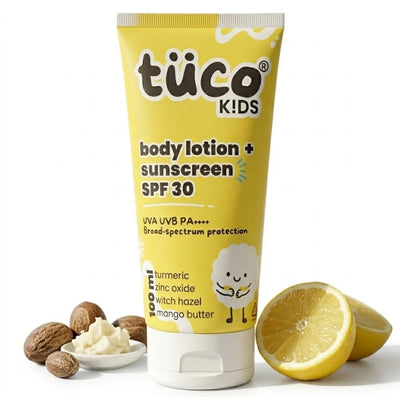
Quick tip: Use different sunscreen formulas for your child's face and body. Our Body Lotion Sunscreen SPF 30 is designed specifically for body application — lightweight enough for daily use, protective enough for India's UV conditions.
Quick View: Face + Body Sunscreen Application Routine
| Step | Area | Product | Timing |
|---|---|---|---|
| 1 | Face | Face sunscreen SPF 50 | 15 min before going out |
| 2 | Arms + hands | Body lotion sunscreen SPF 30 | Same time as face |
| 3 | Legs + feet | Body lotion sunscreen SPF 30 | Same time |
| 4 | Neck & Wars | Either formula | Don't skip these |
| Reapply | All exposed areas | Either formula | Every 2 hours or after swimming |

Face + Body: A Complete Sun Protection Strategy
Most Indian parents are increasingly aware that face sunscreen matters — but the body is often overlooked in the daily routine. UV exposure on arms, legs, and the back of the neck is just as cumulative as exposure on the face. Without body protection, these areas accumulate damage silently over months and years.
A complete sun protection strategy treats the face and body as equally important — but uses different products for each.
Why full body sun protection for kids matters: In India, children spend significant time outdoors — school drop-off and pick-up, recess and sports, after-school activities, and weekend outings. The Indian UV index regularly reaches 8–11 during summer months, meaning even a 20-minute outdoor window without sun protection exposes skin to meaningful UV radiation.
Head-to-toe sunscreen for kids isn't about paranoia. It's about building a sustainable daily habit before UV damage accumulates to a level that causes visible harm. The habit formed between 8–12 years is the one that carries into adulthood.
The face + body split:
- Face: Lightweight face sunscreen (SPF 50 recommended)
- Body: Body lotion sunscreen designed for larger skin surface areas (SPF 30 appropriate for daily use)
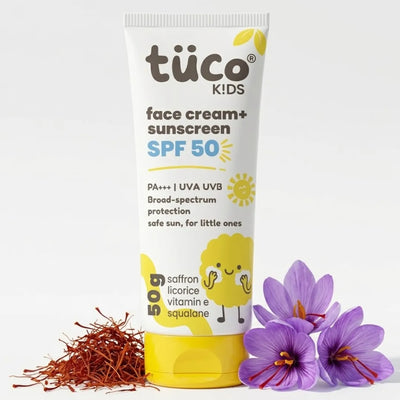
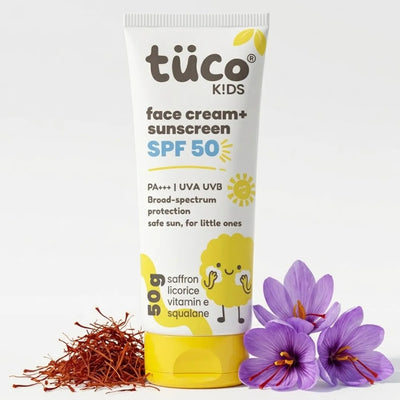
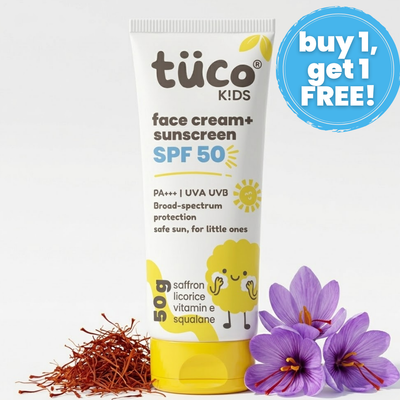
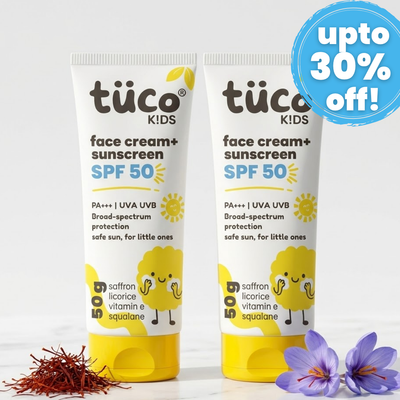
Shop Tuco's Complete Sun Protection Kit with SPF 50 protection 👉

Using the same product for both is convenient but not optimal. Body sunscreen on the face can clog pores; face sunscreen on the whole body gets expensive and runs out too quickly for daily use to be sustainable.
Why Body Sunscreen Needs Are Different
Body sunscreen for kids and facial sunscreen solve different problems. Understanding the distinction helps parents make better decisions about what to buy and how to use it.
Surface area. The body has a significantly larger surface area than the face. Body sunscreens are formulated to spread efficiently over this larger area — slightly richer in texture, making coverage more efficient per application without the formula running thin.
Skin reactivity. Body skin is generally less reactive than facial skin. Body sunscreen formulas can include ingredients that would be too heavy for delicate facial skin — and are formulated for durability and coverage rather than the lighter, eye-safe standards required for face products.

Shop Tuco Haldi Kit with SPF 30 protection 👉
Sweat resistance. Children engaged in outdoor sports, cricket, or active play need sweat-resistant body sunscreen. Look for formulas labelled "water-resistant" — this indicates the formula maintains protection during perspiration and light water exposure.
Easy spreading. Lotion format is ideal for body coverage — it distributes evenly, absorbs quickly, and doesn't leave white residue on clothing. This matters particularly when the application area is large and needs to be covered efficiently in a morning routine.
Best Sunscreen Lotion for Kids' Body (Our Pick)
Body Lotion Sunscreen SPF 30 (100ml) — Our top pick for daily body protection
Broad-spectrum SPF 30 in a lightweight lotion formula built for the specific UV demands of Indian children. Spreads easily over arms, legs, and torso. Non-greasy, fast-absorbing, gentle enough for sensitive skin — and practical for daily all-over use without breaking the budget.
SPF 30 vs SPF 50 for body sunscreen: For body protection during regular daily activity — school commute, outdoor play, after-school sports — SPF 30 is entirely appropriate. SPF 50 offers marginal additional protection (98% vs 97%) at the cost of a heavier formula. For the body, SPF 30 consistently reapplied is more effective in practice than SPF 50 applied once and forgotten.
For maximum protection on high-exposure days — beach trips, full-day outdoor events — pair the Body Lotion Sunscreen with the Complete Sun Protection Kit (SPF 50) on the face.
Face vs Body: Different Products, Same Protection
Can you use face sunscreen on the body? Technically yes, but it's inefficient and expensive. Face sunscreens carry a premium per-ml cost due to specialised ingredients. Using face sunscreen across the full body burns through your supply quickly.
Can you use body sunscreen on the face? Not recommended for regular use. Body formulas are heavier and designed for less reactive skin. Consistent use on the face can contribute to pore congestion and may irritate delicate facial skin over time.
Multi-use sunscreen for kids: If you want one product that covers both, the Complete Sun Protection Kit (SPF 50) is formulated to work on both face and body — it's the exception to the face/body split rule. For parents managing busy morning routines, this is the most practical single-product option.
Sun-Exposed Areas Parents Forget
Even diligent parents miss areas that receive significant UV exposure throughout the day. Here are the most consistently skipped spots:
1. Ears. The tops and outer edges of ears are exposed to direct sunlight all day and sunburn quickly. Apply sunscreen around the ears every time you apply to the face — it takes five seconds and is one of the most commonly burned areas in children.
2. Back of the neck. Especially important for children with short hair or hair worn up. The back of the neck receives direct overhead sunlight during outdoor play and the school commute.
3. Tops of feet. When children are in sandals or go barefoot outdoors, the tops of the feet receive direct sun exposure. Sunburn on feet is painful and recovers slowly.
4. Backs of hands. The tops of hands accumulate significant UV exposure, particularly during outdoor activities. Reapply after handwashing during the school day.
5. Behind the knees. A common sunburn site for children in shorts or skirts. Include it in the leg application routine — it takes an extra few seconds and prevents a surprisingly painful burn.
6. The part in the hair. For children with centre or side-parted hair, the exposed scalp along the part is a real sunburn site. A hat covers this most effectively; sunscreen spray or stick can work on days without a hat.
Daily Routine: How to Layer Face + Body Sunscreen
A structured routine ensures complete coverage and makes sunscreen application a habit rather than a daily negotiation. Here's the recommended sequence:
Morning routine order:
- Face wash — clean skin absorbs sunscreen more evenly
- Moisturiser (if using) — apply first, wait 5 minutes for absorption
- Face sunscreen SPF 50 — 1/4 teaspoon on face, blend in; cover ears and back of neck
- Body lotion sunscreen SPF 30 — apply to all exposed body areas: arms, legs, tops of feet
- Wait 15 minutes — especially important for mineral formulas which need time to bind
- Get dressed — putting on clothes after application avoids rubbing off freshly applied sunscreen
Important order note: Always apply moisturiser first, then sunscreen. Applying moisturiser on top of sunscreen dilutes the SPF concentration and reduces effectiveness. Sunscreen is always the final skincare step before sun exposure.
Building the habit: Connect sunscreen application to an existing morning anchor — after teeth brushing, after breakfast, before getting dressed. Habit-stacking with something already fixed in the routine works far better than treating sunscreen as a separate reminder-dependent task.
Seasonal & Activity-Based Adjustments
Summer (March–September): Maximum UV index across India. Apply SPF 50 on the face and SPF 30 on the body every morning. Reapply every 2 hours during prolonged outdoor activities. This is the season when water-resistant lotion sunscreen for beach or pool days matters most.
Monsoon (June–September): UV levels moderate, but UV-A remains high through cloud cover. High humidity makes heavy formulas feel uncomfortable — a lightweight, fast-absorbing lotion improves daily compliance. Don't skip sunscreen because of cloud cover.
Winter (November–February): UV index is lower, but UV-A damage continues throughout. Maintain daily SPF 30 minimum on exposed body areas. Winter is the season when body sunscreen habits most often lapse.
Sports sunscreen for kids: For outdoor cricket, football, or swimming, use water-resistant formulas and set a reminder for 2-hour reapplication. Reapplication after every swim session is non-negotiable — even "water-resistant" formulas need refreshing after water exposure.
Frequently Asked Questions
What's the difference between sunscreen lotion and sunscreen cream?
Lotion is lighter, spreads more easily, and absorbs faster — ideal for covering the body's larger surface areas efficiently. Cream is thicker, better suited for very dry skin or targeted areas. For active Indian children who need daily full-body coverage, lotion format is the practical daily choice.
Can I use the same sunscreen on face and body?
Not recommended for daily use. Face formulas are lighter and designed to protect against pore clogging; body lotions are thicker for efficient large-area coverage. The Complete Sun Protection Kit (SPF 50) is the exception — formulated to work effectively on both face and body.
Is SPF 30 enough for body sunscreen?
Yes. SPF 30 blocks 97% of UV-B rays and is the standard recommendation for daily body protection. The additional 1% from SPF 50 is marginal in practice. The key variable is consistent application and reapplication every 2 hours.
How long does sunscreen lotion last once applied?
Approximately 2 hours under normal outdoor conditions, or immediately after swimming or heavy sweating. "Water-resistant" claims indicate 40–80 minutes of protection in water — reapplication after every pool or beach session is still required.
What body parts do parents most often forget to apply sunscreen on?
Ears, back of the neck, tops of feet, backs of hands, and behind the knees. These areas receive consistent direct sun exposure and sunburn quickly. Build a quick mental checklist into the routine to cover them.
Should sunscreen be applied before or after moisturiser?
After moisturiser. Apply moisturiser first, wait 5–10 minutes, then apply sunscreen. Applying moisturiser on top of sunscreen dilutes the SPF and reduces effectiveness — sunscreen is always the final skincare step.
Is sunscreen lotion safe for kids with sensitive skin?
Yes, when you choose a fragrance-free, hypoallergenic formula. Test on a small skin area first for very sensitive children. Mineral-based lotion (zinc oxide or titanium dioxide) is typically gentler than chemical UV filter formulas and is the recommended choice for sensitive or reactive skin.
Related reads:
Best Sunscreen for 10 Year Old in India: Age-Specific Guide
Sunscreen for Kids Face: Face-Specific Formula Guide
Best Sunscreen for Kids in India: The Complete Guide