



Sunscreen for Kids Face: Why It's Different (And What to Actually Use)
Body sunscreen on your child's face every morning? It seems harmless — but it's one of the most common mistakes Indian parents make. Face sunscreen for kids has specific formulation requirements that body sunscreen simply doesn't meet, and the difference shows up in breakouts, irritation, and white cast that makes children refuse to wear it.
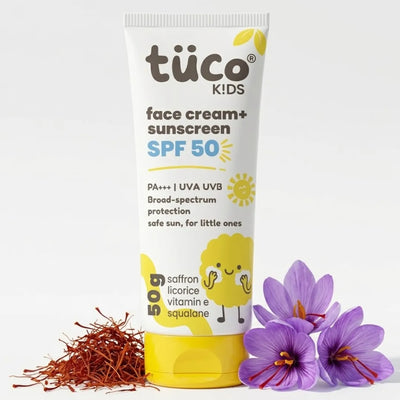
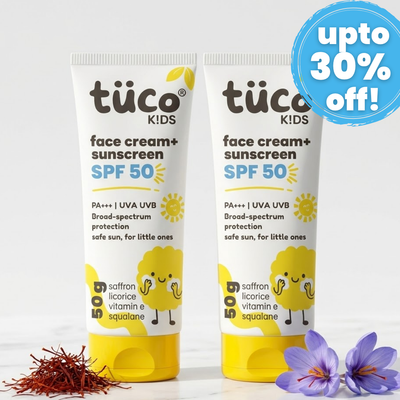
Quick tip: Always use a sunscreen labelled specifically for facial use or "face and body" on your child's face. Our Complete Sun Protection Kit (SPF 50) is designed for exactly this — face and body protection that works across all skin types.

Quick View: Matching Face Sunscreen to Skin Type
| Skin Type | Key Formula Feature | Look For | Avoid |
|---|---|---|---|
| Normal | Lightweight, balanced | Zinc oxide, aloe vera | Heavy oils |
| Dry | Moisturising | Hyaluronic acid, aloe vera | Alcohol-based formulas |
| Oily / Acne-prone | Oil-free, non-comedogenic | Mineral actives, mattifying agents | Coconut oil, lanolin |
| Sensitive | Fragrance-free, hypoallergenic | Titanium dioxide, zinc oxide | Fragrances, oxybenzone |
Why Face Sunscreen Is Different From Body Sunscreen
The skin on your child's face is thinner, more sensitive, and more reactive than the skin on their arms and legs. It's also close to the eyes — which means formulas that are perfectly fine on the body can cause stinging, irritation, or pore congestion when applied to the face daily.
Here's what makes facial sunscreen for kids genuinely different:
Lighter texture. Face formulas are designed to sit lightly on delicate facial skin without feeling heavy or occlusive. Body sunscreen is typically thicker to spread efficiently over large surface areas — that texture is too heavy for a child's face, especially in India's humid climate.

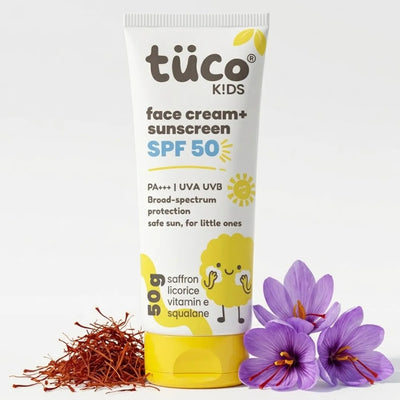
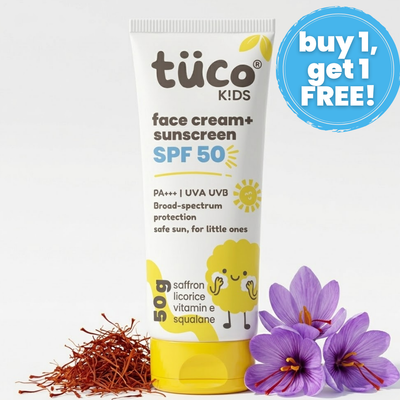
Shop Tuco Saffron Sunscreen for Kids with SPF 50 protection
Non-comedogenic formula. As children approach the preteen years, their pores become more reactive. Face sunscreen that won't clog pores prevents the breakouts that come from applying body-weight formulas to facial skin consistently.
Eye-safe formulation. Face sunscreen is tested and formulated to be non-irritating even near the eye area — critical for children who touch their faces. Body sunscreen is not held to this standard.
No white cast on Indian skin tones. Lightweight facial sunscreen tends to blend more naturally on darker Indian skin tones — a practical daily benefit when your child is heading to school and doesn't want to look like they're wearing a white mask.
Parents who switch from body to face-specific sunscreen consistently report fewer complaints from kids about stinging eyes, heavy skin, and resistance to the daily application routine.
Best Face Sunscreen for Kids: Our Top Picks

1. Complete Sun Protection Kit (SPF 50) — Best for all-round daily protection
Broad-spectrum SPF 50 in a lightweight formula tested across all skin types. Non-greasy, non-comedogenic, and dermatologist-tested — designed specifically for Indian children's skin. Works on both fair and dark skin tones without white cast.
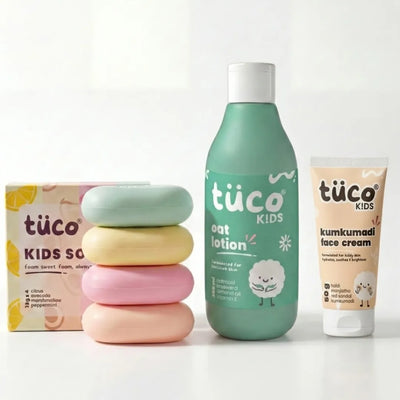
2. Dull Skin Lotion (200ml) — Best for sensitive and pigmentation-prone skin
Ideal for children with uneven skin tone, dullness, or sensitivity. Gentle UV protection with a formula that also works to address dullness — two benefits from one product. Fragrance-conscious and gentle enough for reactive skin types.
Skin Type Matters: Finding the Right Face Sunscreen
Indian children have a wide range of skin types, and face sunscreen should match your child's specific needs. Here's how to select the right facial sunscreen by skin type:
For dry skin: Look for a hypoallergenic face sunscreen for kids that includes hydrating ingredients like aloe vera or hyaluronic acid. These formulas protect while also moisturising — ideal for children in air-conditioned environments. Avoid alcohol-based formulas that will dehydrate skin further.
For oily or combination skin: Oil-free, non-comedogenic sunscreen is the priority. Look for "mattifying" options if your child complains that sunscreen makes their face look shiny by mid-morning.
For sensitive skin: Fragrance-free sunscreen is essential. Stick to mineral actives — zinc oxide and titanium dioxide — which are less likely to cause reactions than chemical UV filters.
For acne-prone or pigmentation-prone skin: Choose sunscreen that is non-comedogenic, oil-free, and fragrance-free. Avoid formulas with heavy emollients like coconut oil or cocoa butter.
The Tuco Kids Dull Skin Lotion (200ml) is particularly suited for sensitive and pigmentation-prone skin — it addresses dullness while delivering gentle protection, without the heavy formulation that triggers reactions in reactive skin types.
Application Tips for Kids' Face (Avoid These Mistakes)
Correct application significantly affects how well even the best face sunscreen performs. Here are the most common mistakes parents make:
Mistake 1: Using too little. The recommended amount for a child's face is about 1/4 teaspoon — roughly the size of a 10-rupee coin placed flat. Most parents apply only 40–60% of this amount. Under-application reduces effective SPF by up to half.
Mistake 2: Rubbing too quickly. Give the formula 20–30 seconds to distribute evenly. Quick, aggressive rubbing causes uneven coverage, especially with mineral formulas that need a moment to blend.
Mistake 3: Avoiding the forehead and nose. These are the highest UV-exposure areas on the face. Many children resist application here — but they're the most critical spots to cover fully.
Sunscreen application steps for kids' face:
- Dot sunscreen on forehead, cheeks, nose, and chin
- Blend outward gently toward the hairline and jawline
- Apply carefully around (not into) the eye area
- Cover the ears and earlobes — often forgotten
- Apply to the back of the neck if hair is worn up
- Wait 15 minutes before outdoor exposure
Daily sunscreen routine for kids: Make it the last step of the morning routine — after face wash and any moisturiser — so it becomes a fixed habit and doesn't get skipped when mornings are rushed.
Does Sunscreen Cause Acne? Myth vs Reality
This is one of the most common questions from parents of 10–12 year olds, and the answer is nuanced.
The myth: Sunscreen causes breakouts and should be avoided if your child has acne-prone skin.
The reality: Heavy, oil-based body sunscreens applied to the face can clog pores and contribute to breakouts. But a properly formulated, non-comedogenic, oil-free face sunscreen designed for kids will not cause acne.
In fact, unprotected UV exposure can actively worsen acne. UV radiation causes inflammation in the skin, which aggravates active breakouts and leads to post-acne hyperpigmentation — the dark spots that linger long after a pimple heals. Daily facial sunscreen actually helps reduce the long-term appearance of acne in children with reactive skin.
Acne-safe sunscreen for kids should be: non-comedogenic, oil-free, fragrance-free, and lightweight. If your child currently avoids sunscreen because it "makes their skin worse," it's almost certainly a formula issue — not a sunscreen issue. Switching to a lightweight, oil-free face sunscreen typically resolves the problem within two weeks of consistent use.
Winter vs Summer: Adjusting Face Sunscreen in India
Many Indian parents skip face sunscreen during winter months — an easy habit to fall into, but one that leads to accumulated UV damage over time.
Summer (March–September): UV index 8–11 in most Indian cities. Use SPF 50 daily; reapply every 2 hours during outdoor activity.
Monsoon (June–September): UV index drops slightly but remains moderate-high (5–7). UV-A rays penetrate clouds fully; UV-B penetrates up to 80%. Maintain daily face sunscreen through monsoon. In high humidity, choose a lightweight formula so discomfort doesn't become an excuse to skip.
Winter (November–February): UV index is lower (3–5) but UV-A, which causes pigmentation and deeper skin changes, remains significant. Maintain SPF 30 minimum for the face during winter.
Frequently Asked Questions
Does sunscreen cause acne in kids?
Non-comedogenic, oil-free face sunscreen won't cause acne. Heavy body sunscreens applied to the face can clog pores and contribute to breakouts. Switching to a lightweight, non-comedogenic face formula typically resolves sunscreen-related breakouts within two weeks.
Can I use body sunscreen on my kid's face?
Not recommended for regular use. Body sunscreen is thicker and designed for less reactive skin over larger areas — not the delicate skin of the face. It can feel heavy, clog pores, and irritate around the eyes. Use a face-specific formula on the face.
Is sunscreen safe around kids' eyes?
Yes, when labelled for facial use. Don't apply directly to eyelids, but applying to the cheekbone close to the eye is safe with a face-formulated sunscreen. Avoid body sunscreen near the eyes entirely.
What sunscreen won't leave a white cast on dark skin?
Look for formulas labelled "no white cast" or blended mineral formulas designed for a range of skin tones. The TucoKids Complete Sun Protection Kit is formulated with Indian skin tones in mind and significantly reduces the white cast common with older mineral formulas.
How much face sunscreen should a child use?
About 1/4 teaspoon (a generous pea-sized amount) for the entire face. Most parents apply only 40–60% of the recommended amount, which significantly reduces the effective SPF their child receives.
Should kids wear sunscreen every day?
Yes. UV damage is cumulative — small daily exposures compound over months and years. Daily face sunscreen is the single most effective long-term skincare habit you can build for your child, regardless of season.
What's the difference between SPF 30 and SPF 50 for kids' faces?
SPF 50 blocks 98% of UV-B; SPF 30 blocks 97%. The difference is marginal in practical terms. SPF 50 is recommended for prolonged outdoor exposure. Both are effective when applied in the correct amount — under-application is a far bigger problem than SPF choice.
Related reads:
Best Sunscreen for 10 Year Old in India: Age-Specific Guide
Best Kids Sunscreen Lotion for Face + Body
Best Sunscreen for Kids in India: The Complete Guide