



Best Natural Winter Skincare Products for Kids: 2026 Buying Guide
Walk down any skincare aisle in winter and you'll find shelves full of products promising to fix dry, flaky, or irritated skin — but not all winter skin care products are created equal, and knowing what to actually look for matters more than any specific brand name. This guide focuses on the ingredients, formulations, and product types that genuinely make a difference for kids' winter skin, so you can shop with real criteria rather than marketing claims alone.
Whether you're building out a full routine or just replacing one worn-out winter skin products staple, understanding what separates a genuinely effective product from one that's merely well-marketed will save both money and frustration this season.
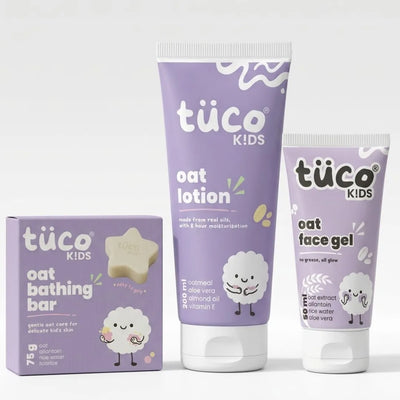
Tuco Kids tip: A single, well-formulated multi-purpose product that covers several winter skin needs at once is often more practical for busy families than assembling a long list of single-purpose items.

Contents
- What to Look For at a Glance
- Ingredients That Actually Matter
- Ingredients Worth Being Cautious Of
- Product Categories You Likely Need
- How to Actually Read a Product Label
- Natural vs. Synthetic: What the Distinction Really Means
- Building Your Shopping List
- Budget Considerations for Winter Skincare
- FAQs
- Related Reads
What to Look For at a Glance
| Product Type | Key Ingredients to Look For | Age Recommendation |
|---|---|---|
| All-purpose daily moisturizer | Oat, shea butter, vitamin E, ceramides | Ages 3+ (Tuco Oat Kit) |
| Gentle cleanser | Fragrance-free, sulfate-free base | All ages, formula-dependent |
| Massage/body oil | Sesame, almond, or coconut oil | 1 month+, patch-tested |
| Lip balm | Shea butter, beeswax, natural oils | All ages |
Ingredients That Actually Matter
Ceramides, naturally occurring lipids that make up a significant part of skin's protective barrier, are genuinely well-supported ingredients for dry, winter-stressed skin, since they directly replenish what skin loses through cold weather exposure. Oat-derived ingredients, including colloidal oatmeal, have solid research support for their soothing, barrier-supporting properties, making them a reliable choice particularly for sensitive or easily irritated skin. Natural oils and butters — shea butter, almond oil, coconut oil — each bring their own useful fatty acid profiles, discussed in more depth in our dedicated ingredient guides. Glycerin and hyaluronic acid, both genuinely effective humectants (ingredients that draw and hold moisture), are worth looking for particularly in lighter, faster-absorbing formulations.
Ingredients Worth Being Cautious Of
Added fragrance, even in products marketed as gentle or natural, is one of the most common causes of skin irritation in kids, and fragrance-free options are generally the safer default choice for winter-stressed, already more reactive skin. Alcohol, particularly denatured alcohol used in some lighter lotions and gels for a quick-drying feel, can actually worsen dryness by stripping skin's natural oils, working directly against the purpose of a winter skincare product. Harsh sulfates in cleansers, while effective at cutting oil and grime, tend to over-strip skin during a season when skin can least afford it, making a gentler, sulfate-free cleanser generally the better winter choice.
Product Categories You Likely Need
A good daily moisturizer, applied post-bath and reapplied as needed through the day, forms the foundation of any winter routine and is worth investing the most consideration into choosing well. A gentle cleanser, distinct from a regular soap, prevents the daily washing process itself from undoing your moisturizing efforts. A dedicated lip balm addresses one of winter's most common and uncomfortable complaints — chapped lips — which standard face or body products don't typically address well given lips' distinct skin structure. A massage or body oil, used a few times weekly, provides the deeper, more intensive moisture support that a daily lotion alone often can't match.
How to Actually Read a Product Label
Ingredients are listed in descending order by concentration, meaning the first several ingredients on a label make up the bulk of the product — a moisturizer listing water first and a beneficial ingredient like shea butter far down the list likely contains far less of that beneficial ingredient than the product's marketing might suggest. Checking for a specific pediatric or dermatologist-tested claim, while not a guarantee of quality on its own, is a reasonable positive signal alongside checking the actual ingredient list rather than relying on marketing claims alone. Being skeptical of vague terms like "natural" or "clean," which have no strict regulatory definition and can be applied to products with meaningfully different actual formulations, helps avoid being misled by packaging language alone.
Natural vs. Synthetic: What the Distinction Really Means
It's worth understanding that "natural" doesn't automatically mean gentler or safer, and "synthetic" doesn't automatically mean harsher — some naturally derived ingredients (certain essential oils, for instance) can be quite irritating, while some lab-created ingredients (like many ceramide formulations) are specifically designed to closely mimic and support skin's natural barrier function effectively. A more useful lens than a strict natural-versus-synthetic divide is evaluating each specific ingredient on its own merits — how well-researched it is, how it performs for the specific skin concern at hand, and how a specific child's skin responds to it individually.
Building Your Shopping List
Does your child have generally healthy skin needing only routine winter support? If yes, a good all-purpose daily moisturizer and gentle cleanser cover most needs without requiring an extensive product list. Does your child have specific problem areas (chapped lips, cracked heels, windburned cheeks)? If yes, add targeted products for those specific concerns rather than assuming one all-purpose product will address everything equally well. Is your child prone to sensitivity or reactions to new products? If yes, prioritize fragrance-free, minimal-ingredient formulations and patch-test any new product before full use. Are you trying to simplify a routine that's become too complicated? If yes, a well-formulated multi-purpose product that addresses several needs at once can reasonably replace several single-purpose items.
Budget Considerations for Winter Skincare
A higher price doesn't automatically correlate with better formulation or results — some of the most genuinely effective ingredients (oat, shea butter, basic ceramides) are relatively affordable, and price often reflects marketing and packaging as much as actual ingredient quality. Investing more in the products used daily and in the largest quantity (a moisturizer, for instance) while being more budget-conscious about less frequently used or smaller-quantity items (a specialty treatment used only occasionally) is a reasonable way to allocate a winter skincare budget sensibly. Buying a slightly larger size of a product you know works well for your child, rather than repeatedly buying smaller sizes of different untested products, often ends up more economical over a full winter season.
FAQs
What are the best winter skin care products for kids to actually look for?
Products featuring ceramides, oat-derived ingredients, shea butter, or natural oils, and free from added fragrance and harsh sulfates, tend to be the most genuinely effective choices for winter-stressed skin.
What winter skin products should form the core of a basic routine?
A good daily moisturizer, a gentle fragrance-free cleanser, a dedicated lip balm, and a massage or body oil used a few times weekly cover most kids' winter skincare needs.
How do I identify the best winter skin care products among so many options?
Check the actual ingredient list rather than marketing claims, prioritize fragrance-free formulations, and look for well-researched ingredients like ceramides and oat-derived compounds near the top of the list.
What winter skin care for dry skin ingredients should I avoid?
Added fragrance, denatured alcohol, and harsh sulfates are worth avoiding, since all three can worsen dryness or cause irritation on already winter-stressed skin.
Does "natural" on a product label actually mean it's better for winter skin?
Not necessarily — some natural ingredients can be irritating while some synthetic ingredients like ceramides are specifically designed to support skin barrier function effectively.
How can I read an ingredient label to judge product quality?
Ingredients are listed by concentration, so checking whether beneficial ingredients appear early in the list, rather than buried near the end, gives a more accurate sense of how much is actually in the product.
Do I need to spend a lot to get effective winter skincare products for kids?
Not necessarily — some of the most effective ingredients are relatively affordable, and prioritizing spend on daily-use items like a core moisturizer over occasional specialty products is a sensible budget approach.