




AC to Cold Air: Managing Skin Transitions for Kids in South Indian Winters
Air conditioning is a year-round fact of life across South India, and winter adds a second layer to the story. ac dry skin kids issues tend to get worse in winter months, not because AC works any differently then, but because it's now working on top of naturally drier outdoor air instead of against humid outdoor air the rest of the year.
Understanding the temperature change skin kids go through as they move between environments explains something that puzzles a lot of parents: why skin can feel dry even when neither the AC room nor the outdoors feels especially extreme on its own.
Tuco Kids tip: It's the repeated back-and-forth between AC and outdoor air — not either environment alone — that tends to stress kids' skin barrier most in winter.

Contents
- TLDR: Quick Comparison
- Why AC Actually Dries Skin (It's Not Just the Cold)
- Managing the Transition, Not Just the Environment
- Smarter AC Settings, Without Giving Up AC
- Recognizing Your Child's Personal AC Pattern
- Managing Transitions by Age
- When to See a Doctor
- FAQs
- Related Reads
| Ingredients | Tuco Product Solution | Key Product Features | Best For |
|---|---|---|---|
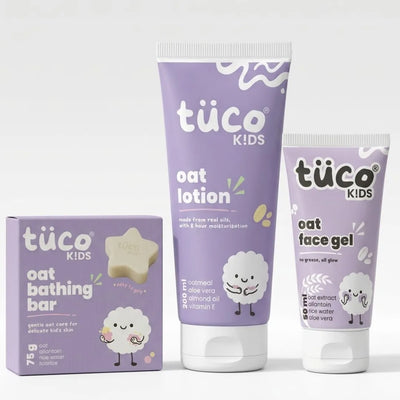
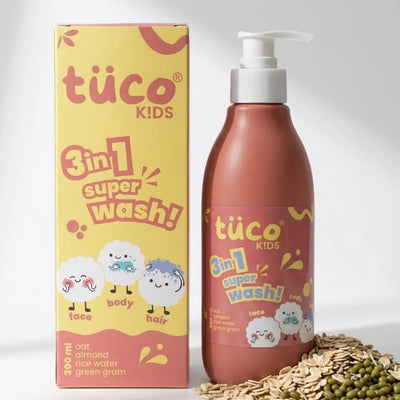
| Oat extract, aloe vera | 3-in-1 Oat Kit | Lightweight, barrier-supporting formula for AC-exposed skin | Daily AC-heavy routines |
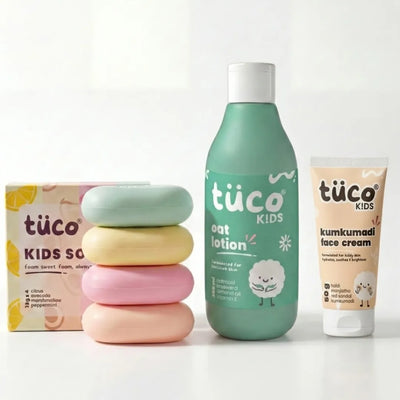
| Turmeric, Kakadu Plum, almond oil | 3-in-1 Bath Kit | Complete everyday soap, lotion, and face cream | General maintenance |
| Shea butter, almond oil, aloe vera | Deep Moisture Body Lotion | Richer option for heavy AC exposure or outdoor time | Noticeably dry patches |
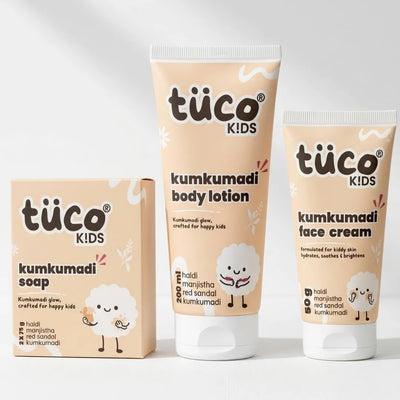
| Saffron, sandalwood, turmeric | 3-in-1 Kumkumadi Kit | Lightweight face care | Daily facial dryness |
Why AC Actually Dries Skin (It's Not Just the Cold)
AC and heaters both leave skin dry, but they get there differently, and the difference is worth knowing. A heater warms air without adding moisture to it, which lowers relative humidity even though the actual water content of the air hasn't changed. An air conditioner does something more direct: as warm air passes over its cold evaporator coil, water vapor in that air condenses into liquid — which is what drips out of your AC unit's drain pipe. That means AC doesn't just make a room feel drier, it genuinely removes water from the air. Indoor AC environments are almost always drier in absolute terms than the outdoor air they're cooling, even on a humid day.
The bigger issue for kids isn't spending time in that dry AC air itself — it's the back-and-forth. Every time a child moves from an air-conditioned classroom or car into humid or dusty outdoor air and back again, their skin barrier has to re-adjust to a new moisture gradient. Do that several times a day, every school day, and the cumulative strain shows up as ac dry skin kids issues that can seem to appear out of nowhere, especially in households that don't think of themselves as having a particularly cold or dry winter.
Managing the Transition, Not Just the Environment
Because the strain comes from repeated shifts rather than any single environment, the fix is consistency across the whole day rather than reacting to each individual transition. A lightweight moisturizer applied in the morning before school, and again in the evening after a full day of AC exposure, covers most of what's needed for kids experiencing temperature change skin kids go through daily. For kids in AC for extended stretches — a full school day, for example — a midday touch-up on hands and lips helps close the gap that builds up by afternoon.
Watch for skin that feels tight or rough specifically after time in AC, along with dry patches on hands, cheeks, and lips that seem to worsen as the day goes on. That daily rhythm — fine in the morning, drier by evening — is usually the clearest sign AC transitions, rather than the season generally, are the main driver, and it's a useful thing to notice because it tells you exactly when reapplication will do the most good.
Smarter AC Settings, Without Giving Up AC
Turning off AC entirely isn't necessary or realistic for most households, but a few adjustments reduce how hard it works against skin. Keeping the temperature moderate rather than very cold matters, since more aggressive cooling condenses out more moisture per hour. Running a small humidifier in a child's bedroom overnight, even with AC on, can meaningfully offset the effect. Where practical, short breaks in naturally ventilated rooms during a long AC stretch also reduce the cumulative strain — not by eliminating AC exposure, but by breaking up the pattern of constant transitions that does most of the damage.
Recognizing Your Child's Personal AC Pattern
Every child's daily AC exposure looks a little different, and figuring out your own family's pattern makes timing moisturizer far more effective than applying it at random. Some kids spend the bulk of their AC time at school, others in a car during a long commute, others mostly at home in the evening. Noticing when dryness tends to show up — right after school pickup, say, or by bedtime — tells you exactly where to focus reapplication.
Once you've spotted the pattern, building a touch-up moment around it — lotion right when your child gets home, or right before bed — turns an occasional afterthought into a habit that actually keeps pace with real exposure. For families with multiple kids in different schools or activities, patterns can vary meaningfully between siblings, so it's worth tailoring the timing individually rather than applying one household rule to everyone.
Shop Deep Moisture Body Lotion →

Managing Transitions by Age
Infants and toddlers are the most sensitive to AC-related dryness and generally do best with a consistent, lightweight moisturizer rather than anything applied only reactively. School-age kids spending long days in AC classrooms benefit most from the simple morning-and-after-school pattern described above. Kids who travel frequently by car face a smaller but real version of the same problem — car AC dries a much smaller volume of air faster, so a lip balm kept in the car for longer drives helps close that particular gap.
When to See a Doctor
Most AC-related dryness responds to a consistent routine within 1–2 weeks. See a doctor if skin cracks, bleeds, shows signs of infection, or doesn't improve with consistent care.
FAQs
Can AC really cause ac dry skin kids issues in winter?
Yes — AC condenses water vapor out of the air as it cools, which removes moisture in absolute terms, not just by feel, and that effect compounds when winter's naturally lower humidity is added on top.
How does temperature change skin kids experience moving between AC and outdoors actually affect the skin barrier?
Each shift forces skin to re-adjust to a new moisture gradient; repeated several times a day, that cumulative adjustment is more taxing than staying in one consistent environment.
Should I turn off AC to protect my child's skin?
Not necessarily — moderate settings combined with consistent moisturizing usually address the issue without giving up AC entirely.
Is ac to outdoor skin transition dryness worse for kids in school all day?
Often yes, since extended AC exposure during school hours accumulates over the day, especially without a midday touch-up.
How do I know if AC is really the cause of my child's dry skin?
If dryness reliably improves on days with less AC exposure and worsens as an AC-heavy day goes on, that pattern is a strong sign AC is the main driver.
Does the type of AC unit change how drying it is?
Split and window units vary somewhat in efficiency, but all AC systems condense moisture out of the air as part of cooling, so the underlying effect is the same across types.
Is car AC worse than home AC for kids' skin?
It can be, since a car is a much smaller volume of air being cooled quickly, which concentrates the drying effect — a quick touch-up after longer drives helps.
Related Reads
- Lip Balm for Kids: Gentle Lip Care Tips for Young Skin
- Best Body Wash for Kids in India: 6 Gentle Picks That Make Bath Time Easier
- The Power of Turmeric: An Ancient Remedy for Kids' Skin Issues
- 10 Best Moisturizing Soaps in India for Dry Skin
- Best Kids Soap in India: Gentle, Safe, and Effective Options for Kids